
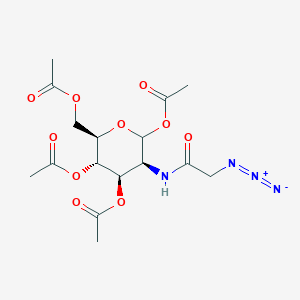
CAS · 361154-30-5
Product Overview
1,3,4,6-Tetra-O-acetyl-N-azidoacetylmannosamine is a high-purity nucleosides-nucleotides supplied for industrial and specialty chemical applications. Contact our team for specifications, packaging options and lead times.
Product Specifications
| Appearance | White to off-white powder |
|---|---|
| Purity (HPLC) | 98% min |
| MS | Conforms to structure |
| H NMR | Conforms to structure |
Applications
1. Metabolic Glycoengineering (MGE)
● Core Use: 1,3,4,6-Tetra-O-acetyl-N-azidoacetylmannosamine丨CAS 361154-30-5 is widely used in MGE to introduce azido groups into the sialic acid residues of cell surface glycans. Cells naturally metabolize Ac₄ManNAz into N-azidoacetylneuraminic acid (SiaNAz), which is incorporated into glycoproteins and glycolipids.
● Utility: This enables tracking, labeling, and manipulation of glycan structures in living cells, allowing researchers to study glycosylation dynamics, cell signaling, and disease progression.
2. Bioorthogonal Chemistry
● The azido group (–N₃) in Ac₄ManNAz can undergo click chemistry, particularly copper-catalyzed azide-alkyne cycloaddition (CuAAC) or strain-promoted azide-alkyne cycloaddition (SPAAC). These reactions allow the conjugation of:
Fluorophores
Biotin
Imaging agents
Drug delivery vehicles
This makes it possible to label and image glycoconjugates in vitro and in vivo with high specificity and minimal interference with native cellular functions.
3. Cell Surface Engineering
● Cell Tracking and Imaging: Ac₄ManNAz is used to label the cell surface glycocalyx with imaging probes (e.g., fluorescent dyes or nanoparticles) via click chemistry.
● Targeted Therapeutics: Modified cells can be directed or targeted using azido groups as handles for site-specific conjugation of therapeutic agents, antibodies, or nanomaterials.
● Stem Cell Research: Enables the monitoring and manipulation of stem cell differentiation through glycan remodeling.
4. Cancer and Disease Research
● Glycan Profiling in Cancer: Aberrant glycosylation is a hallmark of cancer. Ac₄ManNAz can be used to visualize changes in glycosylation during tumor progression, metastasis, or response to treatment.
● Diagnostics: Enables live-cell imaging of glycosylation patterns in real time, which could assist in the development of non-invasive diagnostic tools.
5. Vaccine and Immunology Research
● Antigen Presentation Studies: Ac₄ManNAz is used to study how glycan-modified proteins are presented by immune cells, aiding in vaccine design and understanding immune evasion.
● Immunotherapy: Emerging research uses glycoengineering tools like Ac₄ManNAz to alter cell surfaces for enhanced immune recognition (e.g., engineered tumor cells or immune cells).
Benefits
✅ High Selectivity and Specificity
● Enables precise labeling of sialylated glycans without interfering with other cellular processes.
● Azide groups are absent in nature, which ensures minimal background noise in labeling.
✅ Versatility
● Compatible with a wide range of click chemistry reagents (fluorescent probes, magnetic beads, drugs, etc.).
● Applicable to many cell types, including mammalian cells, stem cells, and even live organisms in zebrafish or mice.
✅ Live-Cell and In Vivo Compatibility
● Peracetylated form (Ac₄ManNAz) facilitates cell membrane permeability, allowing for efficient uptake and metabolism by living cells.
● Suitable for longitudinal studies of glycosylation dynamics in live animals.
✅ Tool for Functional Glycomics
● 1,3,4,6-Tetra-O-acetyl-N-azidoacetylmannosamine丨CAS 361154-30-5 allows researchers to study the biological function of glycans in cell signaling, pathogen-host interactions, immune response, and development.
✅ Non-Genetic, Chemoselective Labeling
● Unlike genetic modification, Ac₄ManNAz labeling is transient and reversible, and does not require manipulation of the cell's genome-ideal for clinical or translational applications.
Conclusion
1,3,4,6-Tetra-O-acetyl-N-azidoacetylmannosamine丨CAS 361154-30-5 is a vital chemical tool in chemical biology, particularly for glycan labeling, bioorthogonal conjugation, and glycoengineering. Its ability to integrate seamlessly into cellular glycans and provide a reactive azide group makes it ideal for a broad range of analytical, diagnostic, and therapeutic applications. From live-cell imaging to targeted drug delivery, Ac₄ManNAz plays a transformative role in modern biomedical research.
Previous
Next