CAS · 118-12-7
Product Overview
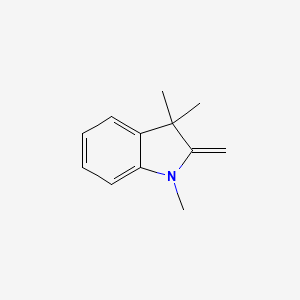
1,3,3-Trimethyl-2-methyleneindoline is a high-purity dyes-pigments supplied for industrial and specialty chemical applications. Contact our team for specifications, packaging options and lead times.
Product Specifications
| Property | Specification |
|---|---|
| Appearance | Red liquid |
| Assay | 97.00% min |
| Moisture | 0.10% max |
| 2,3,3-trimethyl-3H-indoline | 0.50% max |
| Aniline | 0.50% max |
Applications
1. Dye and Pigment Synthesis
● Photochromic and Thermochromic Dyes:
One of the primary applications of 1,3,3-Trimethyl-2-methyleneindoline丨CAS 118-12-7 is in the synthesis of spiropyrans and spirooxazines-photochromic dyes that change color when exposed to light or heat.
● Acts as the indoline precursor in the reaction forming the spiropyran core, essential for:
Smart sunglasses and lenses
UV detection films and sensors
Reversible color-change materials
2. Advanced Materials and Molecular Switches
● Used in developing molecular switches and logic gates due to its ability to undergo reversible structural changes upon external stimuli (e.g., light).
● Critical in the fabrication of optical data storage and photonic devices.
3. Nonlinear Optical (NLO) Materials
● Precursor in the synthesis of organic NLO materials used in:
Telecommunications
Laser protection systems
Optoelectronic devices
The exocyclic double bond in 1,3,3-trimethyl-2-methyleneindoline allows efficient π-conjugation, which enhances optical properties in target molecules.
4. Organic Synthesis and Heterocyclic Chemistry
● Serves as a building block in the synthesis of complex heterocyclic compounds.
● The highly reactive methylene group can participate in Michael additions, cycloadditions, or condensation reactions with various electrophiles.
5. Research and Development
● Extensively studied in academic and industrial research for developing:
Light-responsive materials
New chromophores
Functional dyes for use in solar cells and photocatalysis.
Benefits
1. High Reactivity and Versatility
● The exocyclic methylene group and indoline ring system make it a versatile synthetic intermediate.
● Can react with a wide range of nucleophiles and electrophiles for custom functionalization.
2. Key Intermediate in Photochromic Dye Chemistry
● Essential in the formation of spiropyrans and spirooxazines, which are widely used in smart materials.
● Offers a reliable pathway to light-responsive systems with tunable optical properties.
3. Compact Molecular Structure
● Its small molecular size and three methyl substitutions allow it to be easily modified or incorporated into larger molecules without significant steric hindrance.
4. Enhances Optical Properties
● Enhances π-conjugation and light-absorption behavior in the target molecules, improving their responsiveness and stability under UV exposure.
5. Commercial Availability and Cost-Effectiveness
● It is commercially available and relatively cost-effective, making it suitable for both research-scale and industrial applications.
Conclusion
1,3,3-Trimethyl-2-methyleneindoline丨CAS 118-12-7 is a crucial intermediate in the synthesis of photoresponsive materials, especially spiropyran-based dyes. Its broad utility in organic electronics, dye chemistry, and optical technologies makes it an indispensable compound in materials science and chemical R&D. Its reactivity, versatility, and stability make it a preferred choice for developing innovative light-sensitive and smart materials.
Previous
M-Phenylenediamine丨CAS 108-45-2
Next
Conclusion
A concise summary and suitability assessment for this product is available on request. Contact our team to discuss whether it fits your process and quality requirements.