
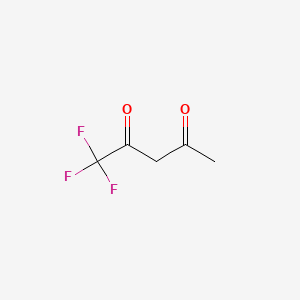
CAS · 367-57-7
Product Overview
1,1,1-Trifluoro-2,4-pentanedione is a high-purity catalysts-auxiliary-agent supplied for industrial and specialty chemical applications. Contact our team for specifications, packaging options and lead times.
Product Specifications
| Appearance | Colorless or light yellowish liquid |
|---|---|
| Assay (GC) | 97.0% min |
| Identification | H-NMR RT of GC |
Applications
1-tert-Butoxy-4-chlorobenzene is an important intermediate used in the synthesis of pharmaceuticals, agrochemicals, and specialty organic compounds. Its substituted aromatic structure and tert-butoxy functionality make it a useful building block in developing more complex aromatic molecules used in drug discovery programs, particularly where steric hindrance and electronic modulation are required. It also serves as a precursor in the preparation of herbicides, fungicides, and insecticides, contributing to structural diversification in crop protection chemistry. The compound is employed in the manufacture of dyes, fragrance intermediates, and functional materials, where its chlorinated aromatic core provides stability and reactivity suitable for electrophilic or nucleophilic substitutions. In material science and polymer modification, it can be used to introduce bulky ether groups into polymer backbones, influencing solubility, thermal properties, and chemical compatibility in specialized polymer formulations.
Benefits
The compound offers several benefits that make it valuable in synthetic chemistry. The tert-butoxy group acts as a bulky, electron-donating substituent, enabling predictable reactivity patterns in aromatic substitution reactions and improving selectivity during multi-step synthesis. The chlorine substituent provides an excellent leaving group for further functionalization, allowing chemists to efficiently introduce diverse substituents through cross-coupling reactions, nucleophilic aromatic substitution, or other transformations. Its stability under standard laboratory conditions enhances handling safety and storage longevity, while its controlled reactivity supports efficient conversion into more complex intermediates. The dual presence of an electron-donating and electron-withdrawing group on the same aromatic ring gives synthetic chemists flexibility in tuning reaction pathways, enabling high-yield transformations and reliable downstream modifications. This chemical versatility supports applications across pharmaceuticals, agrochemicals, and materials research.
Conclusion
1-tert-Butoxy-4-chlorobenzene serves as a robust and adaptable intermediate in organic synthesis. Its combination of a reactive chloro group and a sterically influential tert-butoxy group provides chemists with a flexible platform for constructing structurally diverse and functionally advanced molecules. Its role in drug development, agricultural chemicals, and specialty materials highlights its importance as a foundational building block in modern chemical research and production.
Previous
Potassium Methanesulfonate丨CAS 2386-56-3
Next