
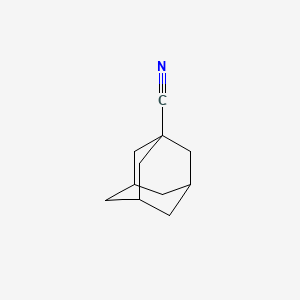
CAS · 23074-42-2
Product Overview
1-Adamantanecarbonitrile is a high-purity pharmaceutical-intermediates supplied for industrial and specialty chemical applications. Contact our team for specifications, packaging options and lead times.
Product Specifications
| Appearance: | Yellowish to Off-white powder |
|---|---|
| Assay: | 98% min |
| Moisture: | 0.5% max |
Applications
1-Adamantanecarbonitrile is a versatile synthetic building block used across medicinal chemistry, organic synthesis, and materials science. In drug discovery it supplies the rigid, lipophilic adamantane scaffold for designing CNS-active molecules, antiviral and antiparkinsonian analogues, and receptor ligands where steric bulk and brain penetration are desirable. The nitrile group serves as a synthetic handle for downstream transformations - hydrolysis to amides/acids, reduction to primary amines, Pinner or Grignard chemistry - enabling rapid elaboration into diverse functionalized adamantane derivatives. It is also used as a precursor for heterocycle construction, cross-coupling or nitrile-directed C–H functionalization, and in the synthesis of advanced organic frameworks. In materials and polymer chemistry, incorporation of the adamantane nitrile unit can increase Tg, rigidity, and thermal/oxidative stability of monomers and resins; it is likewise used in the preparation of dendrimers, ligands for coordination complexes, and small-molecule building blocks for organic electronic or photonic materials. Finally, the compound is employed in SAR studies and as a label/tag to probe steric effects, membrane interactions, and lipophilicity-related ADME properties during lead optimization.
Benefits
The main advantages of 1-adamantanecarbonitrile derive from the unique combination of the adamantane cage and the versatile nitrile functionality. The adamantane core provides a compact, highly rigid, and sterically bulky framework that improves metabolic stability, confers thermal robustness, and often enhances membrane permeability and blood–brain barrier penetration when appended to drug candidates. Its lipophilicity and three-dimensional shape can increase binding affinity through hydrophobic and shape-complementary interactions while reducing conformational flexibility (lower entropic penalty on binding). The nitrile group is a chemically robust yet synthetically flexible handle: it tolerates many reaction conditions and can be converted selectively into amines, amides, carboxylic acids, or serve as a directing/acceptor group in transition-metal catalysis, enabling broad downstream chemistry without excessive protective-group gymnastics. For materials applications, incorporation of the adamantyl nitrile imparts improved mechanical strength, higher glass transition temperatures, and enhanced oxidative/thermal stability to polymers and networks. Additionally, the relatively low polarity and steric shielding around the cage often yield crystalline intermediates with good solid-state handling and purification properties.
Conclusion
1-Adamantanecarbonitrile is a valuable multifunctional intermediate that couples the distinctive physicochemical advantages of the adamantane scaffold with the synthetic versatility of a nitrile group. That combination makes it particularly useful for medicinal chemists seeking rigid, lipophilic appendages to tune potency and CNS exposure, for synthetic chemists needing a robust functional handle for diverse transformations, and for materials scientists designing thermally stable, high-performance polymers and molecular architectures. Its capacity to improve metabolic stability, modulate lipophilicity, and enable a wide array of chemical conversions explains its broad utility in lead optimization, advanced synthesis, and materials development.
Previous
2-amino-6-bromoanisole丨CAS 116557-46-1
Next