
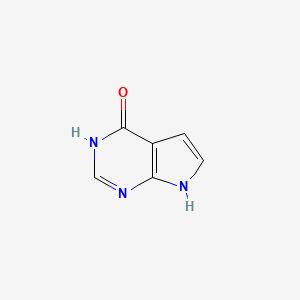
CAS · 3680-71-5
Product Overview
7-Deazahypoxanthine丨CAS 3680-71-5 is a synthetic purine analog that structurally resembles the natural purine base hypoxanthine. It is primarily used in scientific research and has important applications in areas such as molecular biology and chemistry. Below are the key applications and benefits:
Product Specifications
| Property | Specification |
|---|---|
| Appearance | Brownish brown powder |
| Purity (HPLC) | 98% min |
| Water (KF) | 1.0% max |
| Residue on ignition | 1% max |
Applications
1. Nucleoside and Nucleotide Analog Studies:
- Modification of Nucleic Acids: 7-Deazahypoxanthine is used in studies to explore the structural and functional aspects of nucleic acids (DNA and RNA). By replacing hypoxanthine or other purine bases in nucleotides with 7-deazahypoxanthine, researchers can investigate how this alteration affects the behavior and properties of DNA or RNA molecules.
- RNA Structural Studies: This analog can be used to study RNA folding, stability, and interactions, which are crucial in understanding ribosomal function, RNA processing, and gene expression regulation.
2. DNA and RNA Stability Research:
- Research on Base Pairing: 7-Deazahypoxanthine丨CAS 3680-71-5 allows scientists to investigate the impact of modifying nucleobases on the stability of DNA or RNA double strands. Such studies can provide insights into the roles of specific nucleotide bases in the stability and flexibility of nucleic acid structures.
- Alteration of Hydrogen Bonding Patterns: By modifying the base structure, it affects hydrogen bonding patterns between base pairs, helping in studies on DNA/RNA hybridization and mismatch recognition.
3. Drug Design and Development:
- Potential in Drug Design: 7-Deazahypoxanthine and its derivatives may be explored for potential use in drug development, especially as inhibitors or modulators of enzymes that interact with nucleotides or purines. This includes studying its effects on enzymes involved in purine metabolism, DNA replication, and repair processes.
- Antiviral and Anticancer Research: Purine analogs, including 7-deazahypoxanthine, may be studied for potential applications in the treatment of viral infections or cancer. Such analogs can interfere with nucleic acid synthesis, a property that may be harnessed for therapeutic purposes.
4. Enzymatic Reactions Involving Purines:
- Biochemical Assays: It can be used in enzyme studies to explore how specific enzymes interact with purine analogs, which is helpful in understanding enzyme specificity, catalytic mechanisms, and inhibition. For instance, enzymes like adenosine deaminase and xanthine oxidase, which are involved in purine metabolism, could be targeted in such research.
Benefits
1. Tool for Nucleic Acid Research:
- Modifies Nucleic Acid Properties: 7-Deazahypoxanthine offers researchers a way to systematically alter the properties of nucleic acids without disrupting the entire molecular structure. This selective modification allows for detailed investigation into base pairing, nucleic acid interactions, and the roles of purine bases.
2. Improved Stability in RNA Studies:
- Increased Stability: Incorporating 7-deazahypoxanthine into RNA strands can lead to modified RNA molecules that are more stable or behave differently compared to natural RNA. This property is particularly useful for studies that require longer-lasting RNA structures or for exploring RNA-protein interactions.
3. Potential Therapeutic Applications:
- Drug Development Potential: While 7-Deazahypoxanthine丨CAS 3680-71-5 itself may not currently be used as a therapeutic agent, it serves as a model for developing purine analogs that can inhibit or modulate the function of nucleic acid-related enzymes. This holds promise for creating new treatments for diseases like cancer or viral infections.
4. Insight into Nucleotide Base Pairing Mechanisms:
- Advances in Structural Biology: By using 7-deazahypoxanthine, researchers can deepen their understanding of nucleotide base pairing, especially in cases where traditional Watson-Crick base pairs are altered. These insights contribute to knowledge in structural biology and molecular mechanisms of genetic information storage and transmission.
Conclusion:
7-Deazahypoxanthine丨CAS 3680-71-5 is an important research compound used for investigating the structural and functional roles of nucleic acids and enzymes that interact with nucleotides. Its applications in nucleic acid stability studies, enzyme assays, and potential therapeutic uses make it a valuable tool in biochemical and pharmaceutical research. While its direct clinical applications are limited, its role in advancing understanding of purine analogs and nucleic acid biology holds significant scientific value.
Previous
Next
Conclusion
A concise summary and suitability assessment for this product is available on request. Contact our team to discuss whether it fits your process and quality requirements.