
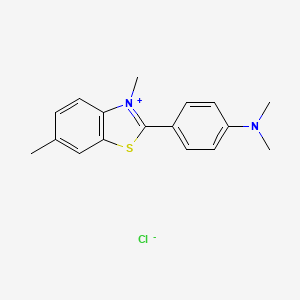
CAS · 2390-54-7
Product Overview
Thioflavine T is a high-purity biochemical-reagents supplied for industrial and specialty chemical applications. Contact our team for specifications, packaging options and lead times.
Product Specifications
| Appearance | Yellow powder |
|---|---|
| Assay | 98% min |
| pH (1% aqueous solution) | 1.5 - 3.0 |
| Moisture (110℃ loss) | 14.0% max |
| ABS (412 nm, 10 mg/L) | 0.76 min |
Applications
Thioflavine T is a fluorescent dye widely used in biochemical research, histology, and neurodegenerative disease studies. It is commonly applied for staining and detecting amyloid fibrils and β-sheet-rich protein aggregates, making it an essential tool in Alzheimer's disease, Parkinson's disease, and related protein misfolding research. In cell biology and molecular studies, Thioflavine T is used in fluorescence microscopy, spectroscopy, and high-throughput screening assays to quantify amyloid formation and monitor protein aggregation kinetics. It also serves as a reference compound in studies evaluating inhibitors of amyloid aggregation, providing insight into therapeutic strategies for neurodegenerative disorders. Additionally, Thioflavine T is utilized in material science research for studying amyloid-like nanostructures and self-assembling peptide systems.
Benefits
The benefits of Thioflavine T arise from its strong binding specificity to β-sheet structures, high fluorescence intensity, and ease of detection. Upon binding to amyloid fibrils, it exhibits a characteristic shift in emission spectra, allowing sensitive and quantitative detection of protein aggregates. Its water solubility and compatibility with common buffers enable simple sample preparation and reproducible experimental results. Thioflavine T provides a rapid, non-destructive, and cost-effective method for monitoring amyloid formation in vitro and in situ. It is also compatible with various analytical techniques, including fluorescence spectroscopy, confocal microscopy, and plate-reader-based assays, supporting high-throughput and detailed mechanistic studies of protein aggregation.
Conclusion
Thioflavine T is a versatile fluorescent dye essential for amyloid research, protein aggregation studies, and neurodegenerative disease investigations. Its strong β-sheet binding, high fluorescence sensitivity, and experimental versatility make it a reliable tool for detecting, quantifying, and analyzing amyloid fibrils and protein aggregates. By enabling precise and reproducible studies of aggregation mechanisms and inhibitor evaluation, Thioflavine T continues to play a critical role in biomedical research and material science applications.
Previous
Ferric Phosphate丨CAS 10045-86-0
Next