
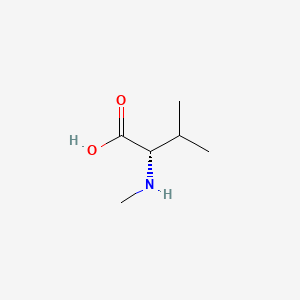
CAS · 2480-23-1
Product Overview
N-Methyl-L-valine is a high-purity biochemical-reagents supplied for industrial and specialty chemical applications. Contact our team for specifications, packaging options and lead times.
Product Specifications
| Appearance | White to off-white solid |
|---|---|
| Purity (HPLC) | 98% Min |
| Specific Rotation [α]20/D | (20.0 ± 2.0)° (c = 1, H₂O): +20.54° |
| Mass Spectrum | In accordance with the structure |
| NMR Spectrum | In accordance with the structure |
Applications
N-Methyl-L-valine is a valuable non-proteinogenic amino acid derivative widely used in peptide synthesis, medicinal chemistry, and biochemical research. Its N-methylated structure introduces conformational constraints and alters hydrogen-bonding patterns, making it a useful building block for designing peptidomimetics, cyclic peptides, enzyme-resistant peptides, and bioactive analogues. It is frequently incorporated into peptide chains to increase steric bulk, modulate backbone flexibility, and improve target selectivity in drug discovery programs. In pharmaceutical development, N-Methyl-L-valine is used to create peptide ligands with enhanced stability against proteolytic degradation, extending biological half-life and improving pharmacokinetic properties. The compound also serves as a precursor in synthesizing specialized intermediates and structural probes used in mechanistic studies of protein–ligand interactions. Additionally, it finds use in combinatorial chemistry libraries, SAR exploration, and the generation of high-throughput screening candidates where modified amino acids are needed to tune molecular behavior.
Benefits
N-Methyl-L-valine offers several important advantages due to its unique steric and electronic properties, enhanced stability, and predictable behavior in synthetic processes. The N-methyl functionality reduces susceptibility to enzymatic cleavage, making peptides that contain this amino acid significantly more resistant to degradation in biological environments. Its structural modification restricts backbone rotation, enabling chemists to fine-tune conformational preferences and improve binding affinity toward specific biological targets. The residue also enhances membrane permeability and oral bioavailability in some peptide-based drug candidates by reducing hydrogen-bond donors. In synthesis, N-Methyl-L-valine exhibits high purity, good solubility in common reaction solvents, and reliable coupling behavior, allowing efficient incorporation into both linear and cyclic peptides with minimal epimerization. Its stable structure and compatibility with modern peptide synthesis strategies make it a practical choice for labs and industry.
Conclusion
N-Methyl-L-valine (CAS 2480-23-1) is a valuable amino acid derivative that plays a significant role in peptide engineering, medicinal chemistry, and the development of stable, high-performance bioactive molecules. Its ability to enhance proteolytic resistance, influence conformational behavior, and improve physicochemical properties makes it an essential building block for designing advanced peptidomimetics and therapeutic peptides. With its strong synthetic reliability and functional versatility, N-Methyl-L-valine continues to be an important tool for research teams and developers seeking to advance next-generation peptide-based technologies.
Previous
6-(N-t-butyloxycarbonylamino)hexyl Bromide丨CAS 142356-33-0
Next
1,2-Distearoyl-sn-glycero-3-phosphoethanolamine丨CAS 1069-79-0