
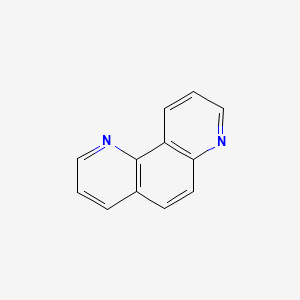
CAS · 230-46-6
Product Overview
1,7-Phenanthroline is a high-purity biochemical-reagents supplied for industrial and specialty chemical applications. Contact our team for specifications, packaging options and lead times.
Product Specifications
| Appearance | Pale yellow or brown solid |
|---|---|
| Purity (HPLC) | 97% min |
| Loss on drying | 2% max |
Applications
1,7-Phenanthroline is widely used as a ligand in coordination chemistry, where it forms stable complexes with transition metals such as copper, iron, nickel, and cobalt. These metal–phenanthroline complexes are applied in catalysis, redox chemistry, and electrochemical systems. In materials science, it serves as a functional ligand in the development of luminescent materials, metal–organic frameworks (MOFs), and supramolecular assemblies. Its strong chelating ability makes it useful in analytical chemistry for metal ion detection and spectrophotometric analysis. In research laboratories, 1,7-phenanthroline is employed as a building block for synthesizing nitrogen-containing heterocycles and advanced functional molecules. Additionally, certain derivatives are investigated for potential biological and pharmaceutical relevance due to their ability to interact with metal-dependent enzymes and nucleic acids. The compound's planar aromatic structure also supports π–π stacking interactions, making it useful in molecular recognition and sensor development.
Benefits
One of the primary benefits of 1,7-Phenanthroline is its strong and selective metal-binding capability, derived from the precise positioning of its nitrogen donor atoms. This allows the formation of stable chelate rings, improving complex stability and catalytic efficiency. Its rigid, conjugated structure enhances electronic communication between metal centers and ligands, supporting applications in photochemistry and optoelectronic materials. The compound exhibits good thermal stability and chemical robustness, enabling use in demanding reaction conditions. From a synthetic standpoint, it is a versatile intermediate that can be readily modified to produce substituted derivatives with tailored electronic or steric properties. Its well-defined coordination behavior also facilitates reproducibility in analytical and research settings. Furthermore, its compatibility with common organic solvents and standard laboratory techniques simplifies handling and integration into various chemical systems.
Conclusion
1,7-Phenanthroline is a valuable heterocyclic ligand widely utilized in coordination chemistry, catalysis, materials science, and analytical research. Its strong chelating ability, structural rigidity, and electronic properties provide significant functional advantages in both academic and industrial applications. As demand continues to grow for advanced metal complexes and functional materials, 1,7-Phenanthroline remains an important building block in modern chemical science.
Previous
Benzyltriphenylphosphonium Chloride丨CAS 1100-88-5
Next