
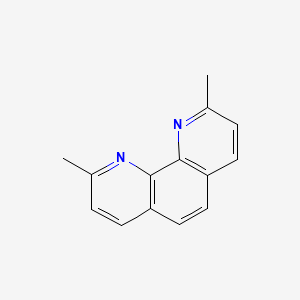
CAS · 484-11-7
Product Overview
Neocuproine is a high-purity analytical-reagents supplied for industrial and specialty chemical applications. Contact our team for specifications, packaging options and lead times.
Product Specifications
| Item | Specification |
|---|---|
| Appearance | White or pale-brown or yellow solid |
| Assay | 99% min |
| Melting Point | 158-163°C |
| Solubility | Clear |
| Water | 5% max |
Applications
1. Analytical Chemistry and Metal Ion Detection
● Metal Ion Complexation: Neocuproine丨CAS 484-11-7 is commonly used as a chelating agent for the detection and quantification of metal ions, especially copper ions (Cu²⁺). The compound forms stable complexes with metal ions, producing distinctive color changes, which can be monitored and quantified.
● Colorimetric Assays: It is used in colorimetric assays for the detection of trace amounts of metals, particularly copper, where it reacts with copper ions to form a bright yellow complex. This is useful in environmental, water quality, and industrial testing.
● Spectroscopic Studies: Neocuproine is also used in spectrophotometry as a reagent for the measurement of copper concentrations in aqueous solutions.
2. Catalysis and Chemical Reactions
● Catalysis in Organic Synthesis: Neocuproine is used as a ligand in transition metal-catalyzed reactions. Its complexes with copper can act as catalysts for reactions such as cross-coupling reactions, oxidation reactions, and other organometallic processes.
● Copper-Catalyzed Reactions: Neocuproine is often used in copper-catalyzed reactions like N-arylation of amines and the cross-coupling of organic molecules, enabling efficient and selective chemical transformations.
3. Research Applications
● Probing Copper in Biological Systems: In biochemistry and molecular biology, neocuproine is used to study copper's role in biological systems, particularly in the context of copper-containing enzymes and proteins. It can also be used in metal ion substitution studies in metalloproteins.
● Complex Formation Studies: Neocuproine is utilized in coordination chemistry research to explore the formation and properties of metal-ligand complexes, especially those involving transition metals like copper, zinc, and iron.
4. Environmental Monitoring
● Water Quality Testing: Neocuproine-based tests are used in water quality analysis to detect copper contamination in water sources. Copper levels can be measured accurately by forming a complex with neocuproine and analyzing the color change or absorbance.
5. Coordination Chemistry and Inorganic Chemistry
● Ligand in Metal Complexes: Neocuproine is an important ligand in coordination chemistry, where it binds to metal ions, particularly transition metals like copper, forming chelate complexes. These complexes have useful properties in areas such as materials science, catalysis, and pharmacology.
● Synthetic Chemistry: Neocuproine's ability to stabilize metal-ligand complexes is used to synthesize a variety of organometallic compounds, which can be applied in materials design or chemical synthesis.
Benefits
√ Effective Chelating Agent
● Neocuproine丨CAS 484-11-7 is an effective chelating agent, particularly for copper ions. This makes it valuable in both analytical chemistry and catalysis, allowing for the precise measurement of metal ion concentrations.
√ Stable Complexes with Metal Ions
● It forms stable, well-defined complexes with copper and other metals, which are used in a variety of synthetic and industrial applications, including catalysis and research.
√ Versatility in Analytical Techniques
● As a colorimetric reagent, it enables easy visual detection of metal ions, particularly copper, and can be used in spectrophotometric methods for quantitative analysis.
√ Catalysis in Organic Reactions
● Neocuproine is a valuable ligand for transition metal-catalyzed reactions, especially those involving copper, facilitating efficient chemical transformations in organic synthesis.
√ Environmental Monitoring
● Its role in detecting copper contamination in water systems makes it a useful tool for environmental monitoring and ensuring safe water quality standards.
√ Use in Biological and Biochemical Studies
● Neocuproine is used to study metal ions in biological systems and to investigate metalloproteins, aiding in understanding the role of metals in biological processes.
Conclusion
Neocuproine丨CAS 484-11-7 is a versatile and valuable compound in analytical chemistry, catalysis, and coordination chemistry. It is particularly useful for metal ion detection, especially for copper ions, in colorimetric and spectrophotometric assays. Its role as a ligand in transition metal-catalyzed reactions and its utility in environmental monitoring further expand its importance. Neocuproine is a key reagent in both scientific research and industrial applications, offering benefits in catalysis, metal ion analysis, and biological studies.
Previous
1,8-Diazafluoran-9-one丨CAS 54078-29-4
Next
Conclusion
A concise summary and suitability assessment for this product is available on request. Contact our team to discuss whether it fits your process and quality requirements.