
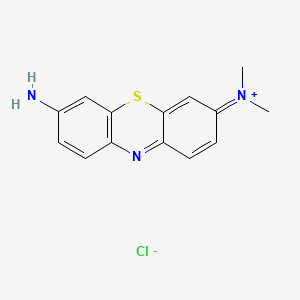
CAS · 531-53-3
Product Overview
Azure A chloride is a high-purity dyes-pigments supplied for industrial and specialty chemical applications. Contact our team for specifications, packaging options and lead times.
Product Specifications
| Grade | BS Grade |
|---|---|
| Appearance | Dark green powder |
| Dyeing test | Pass |
Applications
Azure A chloride is a cationic thiazine dye widely applied in analytical chemistry, histology, and biomedical research. It is primarily used as a staining agent for nucleic acids, mucopolysaccharides, and other biological materials, making it valuable in microscopy and diagnostic applications. In clinical laboratories, it plays an important role in differentiating cell structures and detecting cellular abnormalities. Additionally, Azure A is employed in spectrophotometric and electrochemical studies as a redox-active dye, where its well-defined absorption and redox properties support assays and analytical methods. Beyond biological and chemical applications, it also serves as a research tool in dye-sensitized systems, including studies of electron transfer and photophysical processes.
Benefits
The benefits of Azure A chloride lie in its strong staining ability, reliability, and multifunctional utility. Its affinity for nucleic acids and acidic cell components allows precise visualization under microscopy, supporting accurate histological and cytological analysis. Its high molar absorptivity and well-characterized redox properties make it a dependable choice for analytical and electrochemical experiments. As a water-soluble dye, it is easy to apply and integrate into diverse research protocols. Furthermore, its dual role as both a biological stain and an analytical reagent increases efficiency for researchers, reducing the need for multiple specialized chemicals. This versatility makes Azure A chloride an essential reagent in both biological sciences and material studies.
Conclusion
Azure A chloride (CAS 531-53-3) is a multifunctional dye with significant applications in histology, clinical diagnostics, and analytical research. Its strong staining properties, spectroscopic reliability, and adaptability across disciplines highlight its scientific value. By combining biological and analytical utility, it remains an important tool for advancing both laboratory research and diagnostic methodologies.
Previous
Aluminium 2-ethylhexanoate丨CAS 30745-55-2
Next