
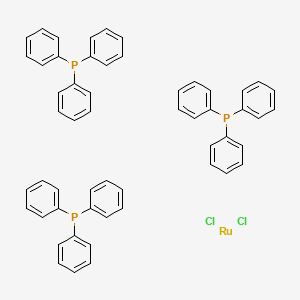
CAS · 15529-49-4
Product Overview
Tris(triphenylphosphine)ruthenium(II) chloride is a high-purity catalysts-auxiliary-agent supplied for industrial and specialty chemical applications. Contact our team for specifications, packaging options and lead times.
Product Specifications
| Appearance | Dark brown to black crystalline powder |
|---|---|
| Purity | 98% min |
| Assay (Ru) | 10.29% min |
| Solubility | Insoluble in water, ether, and n-hexane. Slightly soluble in methanol, ethanol, acetone, ethyl acetate, chloroform, and toluene. Easily decomposed in air. |
Applications
Tris(triphenylphosphine)ruthenium(II) chloride (CAS 15529-49-4) is a highly versatile transition-metal complex widely used as a homogeneous catalyst and synthetic reagent in organometallic and coordination chemistry. It plays a crucial role in hydrogenation, isomerization, hydrosilylation, and coupling reactions such as C–C, C–N, and C–O bond formation. Its exceptional stability and electronic tunability make it a key precursor for designing advanced ruthenium-based catalysts. This compound is also employed in the development of photochemical and electrochemical systems, including fuel cells, photoactive materials, and catalytic hydrogenation of olefins and ketones. In addition, it serves as an intermediate for preparing more reactive ruthenium complexes, such as Grubbs-type catalysts, which are central to olefin metathesis reactions used in fine chemical, polymer, and pharmaceutical industries.
Benefits
The benefits of Tris(triphenylphosphine)ruthenium(II) chloride stem from its excellent catalytic efficiency, stability, and versatility. It exhibits high selectivity under mild reaction conditions, often tolerating a wide variety of functional groups, which makes it ideal for complex organic transformations. The triphenylphosphine ligands contribute to its robust coordination environment, enhancing solubility in organic solvents and allowing precise control of reaction kinetics. Furthermore, the compound's ability to form reactive intermediates with tunable electronic properties facilitates efficient transformations with minimal byproducts, improving both reaction yield and environmental sustainability. Its adaptability across various catalytic systems also makes it valuable for both academic research and industrial-scale synthesis.
Conclusion
Tris(triphenylphosphine)ruthenium(II) chloride is a cornerstone compound in modern organometallic chemistry, offering a balance of stability, reactivity, and selectivity. Its broad catalytic utility-from hydrogenation and metathesis to advanced material synthesis-demonstrates its importance in chemical innovation. By enabling efficient and controllable transformations, this ruthenium complex continues to play a pivotal role in sustainable synthesis, materials science, and the advancement of catalytic technologies.
Previous
Nickel Acetylacetonate丨CAS 3264-82-2
Next