
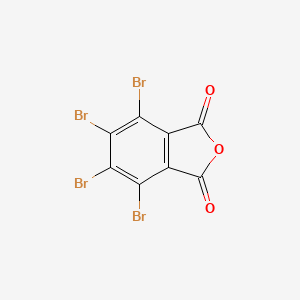
CAS · 632-79-1
Product Overview
Tetrabromophthalic anhydride is a high-purity catalysts-auxiliary-agent supplied for industrial and specialty chemical applications. Contact our team for specifications, packaging options and lead times.
Product Specifications
| Apperance: | White or yellowish powder |
|---|---|
| Bromine content: | 67% min. |
| Sulfate: | 0.3% max. |
| Melting point: | 270℃ min. |
| Moisture: | 0.2% max. |
Applications
1. Flame Retardant
TBPA is widely used as a reactive flame retardant in:
Polyester resins
Epoxy resins
Polyamides
It chemically bonds to polymer chains, making it less likely to migrate or volatilize compared to additive flame retardants.
Suitable for electrical laminates, circuit boards, construction materials, and automotive plastics.
2. Intermediate for Polymeric Flame Retardants
Serves as a starting material for the synthesis of halogenated flame retardant polymers such as brominated polyesters and polyimides.
3. Electronics and Electrical Components
Commonly used in printed circuit boards (PCBs) and plastic housings for electrical devices where stringent flammability standards are required.
4. Polyurethane Foams
Incorporated in the production of flame-retarded rigid and flexible polyurethane foams, commonly used in insulation and cushioning applications.
5. Resins and Varnishes
Used in modifying alkyd, phenolic, or epoxy resins to impart flame resistance without compromising mechanical properties or chemical resistance.
Benefits
🔥 Superior Flame Retardancy
TBPA is rich in bromine (Br), contributing effectively to flame inhibition by releasing bromine radicals during combustion that suppress flame propagation.
🔗 Reactive Incorporation
It reacts into the polymer structure (as an anhydride), ensuring durable flame resistance with reduced environmental leaching or emissions.
🧪 Versatile Chemistry
Compatible with multiple types of thermosetting and thermoplastic systems, offering flexibility in product design.
🌍 Regulatory Compliance
As a reactive flame retardant, it can help manufacturers meet flammability standards like UL 94 V-0, while reducing potential exposure concerns associated with non-reactive brominated additives.
Conclusion
Tetrabromophthalic anhydride (CAS 632-79-1) is a high-performance flame retardant favored in applications requiring permanent, chemically bound fire resistance. Its bromine-rich structure and reactive anhydride functionality make it ideal for integrating into polymers used in electronics, automotive, construction, and consumer goods. TBPA supports fire safety regulations while enabling durable performance, making it a critical component in the formulation of modern flame-retarded materials.
Previous
Platinum Dioxide丨CAS 1314-15-4
Next