
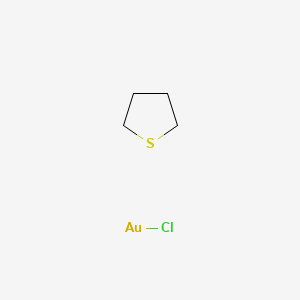
CAS · 39929-21-0
Product Overview
Chloro(tetrahydrothiophene)gold(I) is a high-purity catalysts-auxiliary-agent supplied for industrial and specialty chemical applications. Contact our team for specifications, packaging options and lead times.
Product Specifications
| Appearance | White to off-white powder |
|---|---|
| Assay | 98% min |
| Identification | NMR Complies |
Applications
Chloro(tetrahydrothiophene)gold(I) (CAS 39929-21-0) is a gold(I) coordination complex widely used as a reagent and precursor in organometallic chemistry, catalysis, and nanomaterial synthesis. It serves as a starting material for the preparation of other gold(I) and gold(III) complexes in homogeneous catalysis, including reactions such as hydroamination, cyclization, and cross-coupling. In material science, it is applied in the synthesis of gold nanoparticles, thin films, and conductive coatings due to its ability to deliver gold in a controlled and soluble form. Additionally, it is used in chemical research to study gold-ligand interactions, coordination chemistry, and organogold-mediated transformations.
Benefits
The benefits of chloro(tetrahydrothiophene)gold(I) arise from its high solubility, stability, and reactivity as a gold(I) source. The tetrahydrothiophene ligand stabilizes the gold center while allowing facile ligand exchange, enabling efficient preparation of a wide variety of gold complexes. Its monomeric structure provides predictable reactivity in catalysis and nanoparticle formation. The compound's stability under ambient conditions and ease of handling make it a convenient gold precursor in both laboratory-scale and industrial applications. Its controlled release of gold ions ensures reproducible results in catalytic reactions and material syntheses.
Conclusion
In summary, chloro(tetrahydrothiophene)gold(I) is a versatile organogold compound used in catalysis, organometallic synthesis, and nanomaterial preparation. Its applications include serving as a precursor for gold complexes, catalyzing organic transformations, and producing gold nanoparticles, while its benefits lie in solubility, stability, and controlled reactivity. With these properties, it remains a key reagent in gold chemistry and advanced material research.
Previous
3,5-Diethyl-1-phenyl-2-propyl-1,2-dihydropyridine丨CAS 34562-31-7
Next