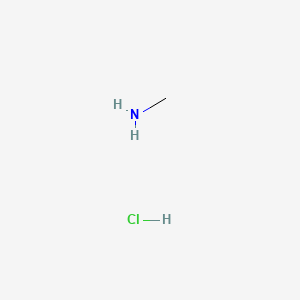
CAS · 593-51-1
Product Overview
Methylamine hydrochloride is a high-purity solar-energy-materials supplied for industrial and specialty chemical applications. Contact our team for specifications, packaging options and lead times.
Product Specifications
| Appearance: | White crystal |
|---|---|
| Assay: | 99% min |
| Water: | 1.0% max |
Applications
1. Pharmaceutical Intermediates
Methylamine hydrochloride is a key building block in the synthesis of a wide range of pharmaceutical compounds. It provides the methylamino group, which is essential for modifying biological activity and improving drug efficacy.
Examples of drugs synthesized using methylamine hydrochloride include:
Antihistamines
Analgesics
Antidepressants
Antihypertensive agents
Local anesthetics
Antibacterial and antifungal agents
It is used in the production of active pharmaceutical ingredients (APIs) like ephedrine, theobromine derivatives, and various sulfonamides.
2. Agrochemicals
Methylamine hydrochloride is also used in the synthesis of pesticides, fungicides, and herbicides. It plays a role in forming methylated nitrogen-containing structures, which are crucial in designing biologically active agrochemicals.
Examples include:
Metolachlor (a widely used herbicide)
Carbamates and organophosphates that require methylamine moieties
3. Organic Synthesis
Methylamine hydrochloride is a versatile reagent in laboratory and industrial organic chemistry. It is used for:
Reductive amination to produce secondary and tertiary amines
Amide formation
N-alkylation reactions
As a precursor for N-methylated compounds, such as methylated heterocycles and amino acids
Its solid form makes it a safer, more convenient alternative to gaseous methylamine.
4. Polymer and Resin Manufacturing
Methylamine hydrochloride can be used in:
Crosslinking agents for resins and adhesives
Modifying polyamide or polyurethane structures
As a precursor in the manufacture of wet-strength agents for paper products
Its use enhances flexibility and adhesion in resins used for coatings, adhesives, and textiles.
5. Dye and Pigment Synthesis
It is utilized in producing azo dyes, methylated dyes, and intermediates for pigments. The methylamino group contributes to color tuning, solubility enhancement, and light fastness.
6. Laboratory and Analytical Reagent
Methylamine hydrochloride is a common reagent in chemical research, used for:
Preparing Schiff bases
Investigating structure–activity relationships in medicinal chemistry
Synthesis of reference compounds
Serving as a buffering agent in some analytical procedures
Benefits
✅ Safe and Convenient Handling
Unlike the gaseous form of methylamine, the hydrochloride salt is stable, non-volatile, and easier to store and transport.
It minimizes exposure risks and simplifies procedures requiring methylamine.
✅ High Reactivity
The compound readily releases the methylamine base under mild conditions, enabling efficient amination, methylation, and condensation reactions.
✅ Versatility
Broad utility across pharmaceuticals, agrochemicals, polymers, dyes, and specialty chemicals.
Compatible with a wide range of organic reactions, including nucleophilic substitution and acid-base reactions.
✅ Water Solubility
Its high solubility in water allows for aqueous-phase synthesis and easy reaction work-up, particularly in pharma and biotech labs.
✅ Cost-Effective
Available in large volumes at competitive cost, making it suitable for both industrial-scale synthesis and R&D use.
Conclusion
Methylamine hydrochloride (CAS 593-51-1) is a crucial intermediate in modern chemical synthesis. From pharmaceuticals to agrochemicals, dyes to polymers, its ability to reliably introduce the methylamino group makes it an indispensable reagent. Its stability, safety profile, and wide applicability ensure its continued demand in industrial and research applications.
Previous
Lithium Bis(trifluoromethanesulphonyl)imide丨CAS 90076-65-6
Next