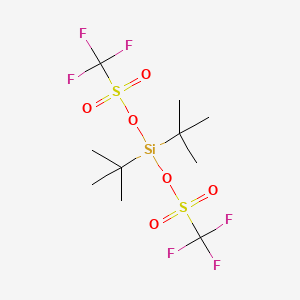
CAS · 85272-31-7
Product Overview
Di-tert-butylsilyl bis(trifluoromethanesulfonate) is a high-purity silicon-compounds supplied for industrial and specialty chemical applications. Contact our team for specifications, packaging options and lead times.
Product Specifications
| Appearance: | Colorless to yellow or colorless to light brown-yellow liquid |
|---|---|
| Purity (1HNMR): | 97% min |
| Identity (by 1HNMR): | Conforms |
Applications
1. Organosilicon Chemistry
a. Silylation Reactions:
As a highly reactive silylating agent, Di-tert-butylsilyl bis(trifluoromethanesulfonate)丨CAS 85272-31-7 is used in silicon-based chemistry, where it plays a key role in:
● Protecting the hydroxyl group in alcohols, phenols, and other nucleophilic species.
● Introducing silyl groups into molecules, which can influence their reactivity and stability in subsequent reactions.
b. Formation of Organosilicon Compounds:
This reagent is utilized in the synthesis of functionalized silicon intermediates, which can be further processed into specialized materials, including those used in electronic devices, coatings, and adhesives.
2. Protection of Hydroxyl and Amino Groups
a. Temporary Protection in Multistep Synthesis:
In complex organic syntheses, the di-tert-butylsilyl group serves as a temporary protecting group for hydroxyl (–OH) or amino (–NH2) functionalities. This allows for selective reactions in multi-step synthetic routes without interference from these functional groups.
This protecting group is especially useful when hydroxyl groups are reactive under the conditions used for the synthesis of other functionalities, like C–C bond formation or oxidation reactions.
b. Selectivity in Functional Group Manipulation:
The combination of the triflate groups with the silyl functionality enhances the selectivity of the compound in targeting specific functional groups while leaving others intact. This makes it valuable for highly selective functional group manipulations in complex molecules.
3. Catalysis and Synthesis of Silicon-Based Polymers
a. Catalytic Reactions:
In catalytic processes, di-tert-butylsilyl bis(trifluoromethanesulfonate) can be used to activate or protect certain intermediates, enhancing reaction efficiency, particularly in silicon-based catalysis.
b. Silicon-Containing Polymers:
This compound is often employed in the synthesis of silicon-based polymers (such as siloxanes) that are used in a wide range of applications, including:
● Coatings
● Sealants
● Electronics
It provides excellent control over the structure and functionality of the polymer chains, improving their overall properties.
4. Reaction with Fluorine-Containing Reagents
Due to its triflate groups (CF₃SO₃), di-tert-butylsilyl bis(trifluoromethanesulfonate) can serve as a reagent in reactions that involve fluorine-containing compounds or systems. The triflate group, being highly electrophilic, can engage in reactions that require a source of electrophilic triflate ions, such as:
● Fluorine substitutions
● Formation of fluorinated intermediates or compounds
This can be valuable in the synthesis of fluorine-containing materials, which are critical in sectors like pharmaceuticals, agrochemicals, and materials science.
Benefits
1. Highly Selective Protecting Group
Di-tert-butylsilyl bis(trifluoromethanesulfonate)丨CAS 85272-31-7 provides a highly selective protecting group that is effective in protecting hydroxyl and amino groups without interference from other functional groups in a molecule. Its combination of steric hindrance (from the bulky tert-butyl groups) and electrophilic triflate groups offers controlled reactivity in complex synthetic routes.
2. Stability and Reactivity Control
The compound is relatively stable under a variety of reaction conditions but can be easily activated or deprotected when needed. This stability combined with its reactivity in targeted reactions allows for precise control in multi-step synthetic procedures.
3. Enhances Functional Group Manipulation
By protecting sensitive groups and enhancing the reactivity of other groups, di-tert-butylsilyl bis(trifluoromethanesulfonate) facilitates the regioselective and chemoselective manipulation of complex molecules. This makes it indispensable in the synthesis of targeted molecules for pharmaceuticals, agrochemicals, and high-performance materials.
4. Solubility and Compatibility
The silyl and triflate groups make the compound compatible with a wide range of organic solvents, enhancing its utility in organic synthesis and catalysis. Its solubility profile also ensures that it can be used in solution-phase reactions and solid-phase processes, making it versatile for various applications.
5. Enhanced Efficiency in Silicon-Based Polymer Synthesis
In the synthesis of silicon-containing polymers, the reagent enables precise control over the polymer's structure and functionality. This is important in the development of high-performance materials used in industries such as electronics, aerospace, and automotive manufacturing.
Conclusion
Di-tert-butylsilyl bis(trifluoromethanesulfonate)丨CAS 85272-31-7 is a highly valuable reagent in organosilicon chemistry and organic synthesis. Its role as a protecting group for hydroxyl and amino groups, along with its utility in forming silicon-based intermediates and polymers, makes it indispensable in various chemical and material science fields. Its selectivity, stability, and ability to facilitate complex synthetic procedures make it an essential tool in both academic and industrial research, particularly in the development of high-performance materials and fluorine-containing compounds.
Hot Tags: di-tert-butylsilyl bis(trifluoromethanesulfonate)丨cas 85272-31-7, China di-tert-butylsilyl bis(trifluoromethanesulfonate)丨cas 85272-31-7 manufacturers, suppliers, factory, silicon compounds, CAS 9006 65 9, Dimethicone, 2554 06 05 00 00 00, 9006-65-9, CAS 2554 06 5
Previous
Hexamethyldisilazane丨CAS 999-97-3
Next