
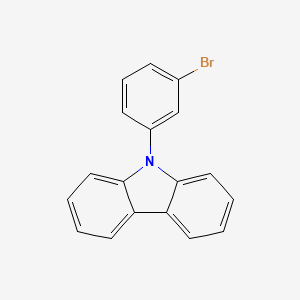
CAS · 185112-61-2
Product Overview
N-(3-Bromophenyl)carbazole | CAS 185112-61-2 is an advanced organic compound utilized in the field of organic synthesis and materials science. Known for its distinctive chemical properties, this compound is a valuable building block in the development of materials for electronic and optoelectronic applications.
Product Specifications
| Appearance | Off White powder |
|---|---|
| Purity | 99%min |
Applications
1.Organic Electronics and Optoelectronics:
- OLEDs and Light-Emitting Applications: N-(3-Bromophenyl)carbazole plays a pivotal role in the synthesis of materials for organic light-emitting diodes (OLEDs), contributing to enhanced luminescence efficiency and device lifespan.
- Semiconducting Polymers: This compound is integral in the creation of semiconducting polymers, which are widely used in optoelectronic devices such as organic field-effect transistors (OFETs) and organic photovoltaics (OPVs).
2.Polymer Chemistry:
- Monomer in Polymer Development: As a monomer, N-(3-Bromophenyl)carbazole enables the synthesis of high-performance polymers with fine-tuned electronic and optical properties.
- Copolymer Applications: It is employed in the production of copolymers that exhibit improved processability and stability, essential for high-end optoelectronic systems.
3.Materials Science and Photonics:
- Advanced Electronic Materials: N-(3-Bromophenyl)carbazole | CAS 185112-61-2 is utilized in designing materials with excellent charge transport and photophysical properties, critical for devices like photodetectors and sensors.
- Photoconductive Applications: Its derivatives are employed in creating photoconductive materials with high sensitivity, suitable for imaging technologies.
4.Thin-Film Transistors (OTFTs):
- This compound is instrumental in the development of OTFTs used in flexible displays, wearable technology, and other innovative electronics requiring lightweight and flexible materials.
Benefits
1.Versatility in Synthesis:
- Its structure allows for easy functionalization, making it a flexible intermediate in creating complex polymers and materials tailored for specific applications.
2.Enhanced Electronic and Optical Properties:
- Materials synthesized from N-(3-Bromophenyl)carbazole | CAS 185112-61-2 exhibit superior charge transport, photoluminescence, and thermal stability, ensuring reliable device performance.
3.Stability and Longevity:
- The compound contributes to the development of materials with exceptional thermal and chemical stability, crucial for durable electronic devices.
4.Tunable Properties:
- By incorporating N-(3-Bromophenyl)carbazole, researchers can precisely control material properties like bandgap and light absorption, optimizing performance for OLEDs, solar cells, and more.
5.Support for Emerging Technologies:
- It is a foundational material in the pursuit of next-generation technologies, including flexible electronics, organic solar panels, and high-efficiency light sources.
Conclusion
A concise summary and suitability assessment for this product is available on request. Contact our team to discuss whether it fits your process and quality requirements.