
9-(1,1-biphenyl-3-yl)-3-(4,4,5,5-tetramethyl-1,3,2-dioxaborolan-2-yl)-9H-carbazole
CAS 1533406-38-0
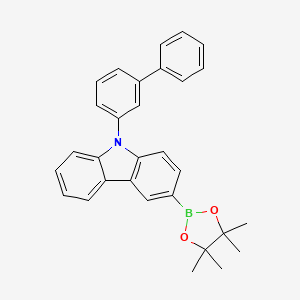
CAS · 1533406-38-0
Product Overview
9-(1,1-biphenyl-3-yl)-3-(4,4,5,5-tetramethyl-1,3,2-dioxaborolan-2-yl)-9H-carbazole is a high-purity oled-materials supplied for industrial and specialty chemical applications. Contact our team for specifications, packaging options and lead times.
Product Specifications
| Appearance: | white powder |
|---|---|
| Purity (HPLC): | 99.5% min |
| MP: | 237~240 deg.C |
Applications
1. OLED Material Synthesis
Primarily used as an intermediate or building block in the development of organic light-emitting diodes (OLEDs).
Carbazole and biphenyl structures enhance hole-transporting properties, while the boronic ester group allows for Suzuki coupling in OLED synthesis.
2. Organic Electronics
Utilized in optoelectronic devices such as:
Organic field-effect transistors (OFETs)
Organic photovoltaic cells (OPVs)
Light-emitting transistors
3. Suzuki-Miyaura Coupling Reactions
The boronic ester group makes it highly suitable for cross-coupling reactions in organic synthesis, particularly for creating larger π-conjugated systems.
4. Material Science Research
Used in research for designing high-efficiency emissive materials, especially those with thermal and photostability for long device lifetimes.
Benefits
High Reactivity: Boronic ester group offers excellent coupling efficiency.
Thermal Stability: Carbazole core improves thermal durability in electronic applications.
Optoelectronic Performance: Promotes efficient charge transport and emission properties.
Versatile Intermediate: Allows modular functionalization in complex molecule construction.
Conclusion
9-(1,1-Biphenyl-3-yl)-3-(4,4,5,5-tetramethyl-1,3,2-dioxaborolan-2-yl)-9H-carbazole (CAS 1533406-38-0) is a high-value compound in the field of organic electronics and materials science. Its unique structure combines electron-rich carbazole, a biphenyl unit for extended conjugation, and a boronic ester group ideal for cross-coupling chemistry. This makes it indispensable in the design and synthesis of advanced materials for OLEDs and other optoelectronic devices.
Previous
9-Bromo-10-(2-naphthyl)anthracene丨CAS 474688-73-8
Next
N-(1,1-biphenyl-4-yl)dibenzob,dthiophen-2-amine丨CAS 1300028-93-6