
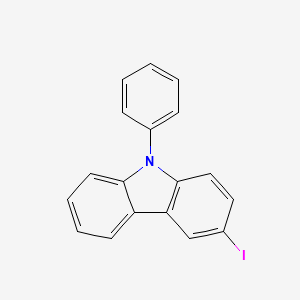
CAS · 502161-03-7
Product Overview
3-Iodo-N-phenylcarbazole丨CAS 502161-03-7 is an advanced organic compound widely utilized in the fields of organic synthesis, materials science, and optoelectronics. Its unique structure combines the carbazole framework with an iodine substituent and a phenyl group, enabling versatile chemical reactivity and significant contributions to the development of cutting-edge technologies.
Product Specifications
| Appearance | Off-white powder |
|---|---|
| Purity | 99.9% min |
Applications
1. Organic Electronics and Optoelectronics:
- OLEDs and Display Technologies: 3-Iodo-N-phenylcarbazole is frequently used as a precursor in the development of materials for organic light-emitting diodes (OLEDs). It enhances electroluminescent properties, contributing to brighter and more energy-efficient displays.
- Organic Photovoltaics (OPVs): As a key intermediate in conjugated polymer synthesis, this compound aids in creating donor-acceptor systems that improve light absorption and charge separation, optimizing solar cell efficiency.
- Organic Semiconductors: The compound's structure supports the design of materials with high charge mobility, crucial for organic field-effect transistors (OFETs) and other electronic components.
2. Materials Science:
- Advanced Material Design: 3-Iodo-N-phenylcarbazole丨CAS 502161-03-7 plays a role in designing materials with tailored electronic and optical properties. Its incorporation into various matrices results in materials with enhanced stability and performance in demanding applications.
- Photoconductive Applications: It contributes to photoconductive materials used in imaging systems, photodetectors, and related technologies, ensuring sensitivity and reliability.
3. Polymer Chemistry:
- Monomer for Conjugated Polymers: The compound serves as a valuable building block for the synthesis of conjugated polymers. It enables fine-tuning of polymer properties such as processability, electronic characteristics, and thermal stability.
- Functional Copolymers: Its derivatives are integrated into copolymers with optimized optoelectronic properties, making them suitable for diverse industrial and technological applications.
4. Electroluminescent Devices:
- Light-Emitting Materials: 3-Iodo-N-phenylcarbazole is used in the development of light-emitting layers for electroluminescent devices, contributing to better performance and extended operational lifetimes.
5. Chemical Intermediates:
- Synthesis of Complex Molecules: The iodine substituent offers a reactive site for further functionalization, allowing the synthesis of complex organic molecules and polymers with unique properties.
Benefits
1. Versatility in Synthesis:
- Its reactive iodine atom allows for diverse functionalization, enabling the creation of tailored compounds for specific applications.
2. Enhanced Optoelectronic Properties:
- Compounds derived from 3-Iodo-N-phenylcarbazole demonstrate high photoluminescence and charge mobility, making them ideal for high-performance electronic devices.
3. Stability in Harsh Conditions:
- Materials incorporating this compound exhibit excellent thermal and chemical stability, ensuring reliable performance in demanding applications.
4. Scalability and Integration:
- The compound is suitable for integration into large-scale production processes, supporting the cost-effective manufacture of advanced technologies.
Conclusion
A concise summary and suitability assessment for this product is available on request. Contact our team to discuss whether it fits your process and quality requirements.