
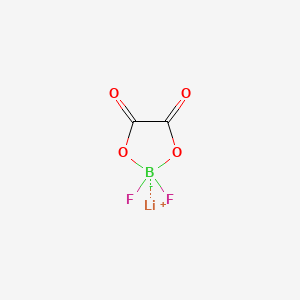
CAS · 409071-16-5
Product Overview
Lithium Difluoroxalate Borate (LiODFB), CAS 409071-16-5, is an advanced lithium salt used primarily in energy storage applications. Known for its high ionic conductivity and excellent thermal stability, LiODFB is a valuable component in the manufacture of lithium-ion batteries, contributing to enhanced safety, longevity, and performance. Below, we explore the applications, benefits, and handling considerations of LiODFB.
Product Specifications
| Property | Specification |
|---|---|
| Grade | Battery grade |
| Appearance | White powder or crystal |
| Assay | 99.8% min |
| Water | 200 ppm max |
| Insoluble | 0.2% max |
| Na | 20 ppm max |
| K | 20 ppm max |
| Ca | 20 ppm max |
| Fe | 10 ppm max |
| Pb | 5 ppm max |
| SO₄ | 20 ppm max |
Applications
1.Energy Storage and Battery Systems:
- Lithium-Ion Batteries: LiODFB is commonly used as an electrolyte additive in lithium-ion batteries for electric vehicles, consumer electronics, and renewable energy storage systems. It enhances the battery's capacity retention and minimizes the risk of degradation over repeated charging cycles.
- High-Performance Battery Cells: In high-temperature environments, LiODFB's thermal stability is particularly beneficial, making it suitable for high-performance battery cells that require reliable operation in demanding conditions.
2.Electric Vehicles (EVs):
- Battery Safety Enhancement: In EV batteries, LiODFB丨CAS 409071-16-5 acts as a stabilizing agent, reducing the risk of overheating and thermal runaway, thereby contributing to the overall safety and reliability of EV systems.
- Extended Lifespan for Automotive Applications: The inclusion of LiODFB in EV battery systems helps extend the battery lifespan, enhancing the performance and longevity of electric vehicles.
3.Grid Energy Storage:
- Renewable Energy Integration: LiODFB improves battery cycle life and capacity retention, making it suitable for grid-level energy storage solutions that support renewable energy sources like solar and wind.
- Stable, Long-Term Storage: For applications requiring long-term energy storage stability, LiODFB's chemical properties help maintain battery performance over extended periods, minimizing energy loss and capacity fade.
Benefits
1.Enhanced Electrochemical Stability
- Reduces Decomposition: LiODFB helps reduce electrolyte decomposition at high voltages, resulting in longer-lasting batteries with consistent output and performance.
- High Ionic Conductivity: With its superior ionic conductivity, LiODFB enables faster ion transport within the battery, improving power delivery and efficiency.
2.Thermal and Chemical Stability
- Resistant to Thermal Degradation: LiODFB丨CAS 409071-16-5 is highly resistant to thermal breakdown, which is essential for applications in high-temperature environments or where batteries may be subjected to varying temperatures.
- Stable in High Voltage Environments: The stability of LiODFB at high voltages makes it a preferred choice in high-energy-density battery designs.
3.Enhanced Safety Profile:
- Mitigates Risk of Thermal Runaway: By stabilizing the electrolyte and reducing potential decomposition, Lithium Difluoroxalate Borate minimizes the risk of thermal runaway, contributing to safer battery operation.
- Low Gassing Tendency: LiODFB's low tendency to release gas during operation adds to battery safety, making it ideal for confined applications and environments where safety is a top priority.
4.Improved Battery Cycle Life:
- Minimizes Capacity Fade: LiODFB helps prevent capacity fade over repeated charge cycles, contributing to a longer operational lifespan for lithium-ion batteries.
- Consistent Performance in Cyclic Applications: For applications that require frequent recharging, Lithium Difluoroxalate Borate ensures batteries maintain consistent performance and capacity over time.
Conclusion
A concise summary and suitability assessment for this product is available on request. Contact our team to discuss whether it fits your process and quality requirements.