
CAS · 79-77-6
Product Overview
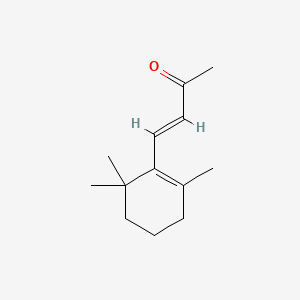
4-(2,6,6-Trimethyl-1-cyclohexenyl)-3-buten-2-one is a high-purity essences-and-fragrances supplied for industrial and specialty chemical applications. Contact our team for specifications, packaging options and lead times.
Product Specifications
| Grade | Food Grade |
|---|---|
| Appearance | Light yellow to yellow liquid |
| Purity (GC) | 97.0% min |
| Aroma | Has a warm, woody, and dry aroma |
| Refractive Index (20°C) | 1.5180 to 1.5220 |
| Relative Density (25/25°C) | 0.9400 to 0.9450 |
| Solubility (25°C) | 1 mL completely soluble in 3 mL of 70% ethanol |
Applications
4-(2,6,6-Trimethyl-1-cyclohexenyl)-3-buten-2-one is widely used as a key intermediate in flavor, fragrance, and fine chemical synthesis. It serves as a building block for the production of natural and synthetic aroma compounds, including carotenoid-derived fragrances, musks, and floral or fruity scent molecules. In perfumery and cosmetic research, it is applied to design and formulate fragrance compositions with stable, long-lasting profiles. The compound is also employed in the synthesis of specialty chemicals and intermediates where α,β-unsaturated ketone functionality enables further chemical transformations such as condensation, cyclization, and addition reactions. In laboratory research, it is used to explore structure–activity relationships and optimize synthetic pathways for aroma and flavor compounds.
Benefits
The compound offers several advantages due to its conjugated ketone and cyclic structure. Its α,β-unsaturated carbonyl group provides high reactivity for selective chemical transformations, supporting efficient synthesis of derivatives and target molecules. The trimethylcyclohexenyl moiety contributes to stability, lipophilicity, and desirable olfactory properties in fragrance applications. Its well-defined chemical structure ensures reproducible reactions, predictable behavior, and consistent quality in industrial and laboratory settings. Additionally, the compound is compatible with common organic solvents and reaction conditions, facilitating smooth incorporation into synthetic and formulation processes. These characteristics make it a reliable intermediate for producing high-value aroma and flavor products.
Conclusion
4-(2,6,6-Trimethyl-1-cyclohexenyl)-3-buten-2-one is a versatile intermediate in the synthesis of fragrances, flavor compounds, and specialty chemicals. Its applications in aroma design and chemical synthesis, combined with benefits such as high reactivity, stability, and predictable performance, make it an important building block in perfumery and fine chemical research. The compound continues to support the production of high-quality, value-added olfactory and functional materials.
Previous
Quinine Hydrochloride丨CAS 130-89-2
Next