
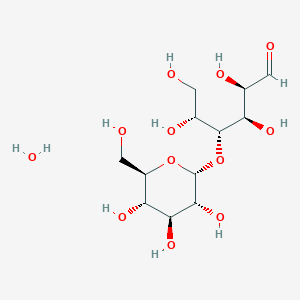
CAS · 6363-53-7
Product Overview
D-(+)-Maltose monohydrate, with the Chemical Abstracts Service (CAS) number 6363-53-7, is a disaccharide composed of two glucose units linked by an α(1→4) glycosidic bond. It is commonly found in nature and is a product of starch hydrolysis. D-(+)-Maltose monohydrate is widely used in the food industry, biotechnology, and research due to its sweetening properties, nutritional value, and role as a carbohydrate source.
Product Specifications
| Property | Specification |
|---|---|
| Appearance | White or almost white |
| Identification | Positive |
| pH | 4.5 - 6.5 |
| Sulfated Ash | 0.1% Max |
| Residue on Ignition | 0.1% Max |
| Lead | 4 ppm Max |
| Arsenic | 1 ppm Max |
| Heavy Metals | 4 ppm Max |
| Chloride | 200 ppm Max |
| Sulfate | 240 ppm Max |
| Water Content (K-F, before drying) | 4.5% - 6.5% |
| Specific Optical Rotation (before drying) | 126° - 131° |
| Specific Optical Rotation (after drying at 80°C for 4 hours) | 135° - 139° |
| Purity | 98.0% Min |
| Glucose (HPLC) | 3.0% Max |
| Endotoxin Level | 1.0 EU/g Max |
| Total Aerobic Bacteria | 1000 cfu/g Max |
| Mold and Yeast | 100 cfu/g Max |
| E. Coli | Negative |
| Salmonella | Negative |
Applications
1. Food Industry:
- Sweetener: D-(+)-Maltose monohydrate丨6363-53-7 is used as a sweetening agent in various food products, including confectionery, baked goods, and beverages. It provides a mild sweetness and enhances flavor profiles.
- Fermentation Substrate: It serves as a fermentable sugar in the production of beer, sake, and other fermented beverages.
- Stabilizer and Humectant: Maltose is used to stabilize and retain moisture in food products, improving texture and shelf life.
2. Biotechnology and Microbiology:
- Culture Medium: D-(+)-Maltose monohydrate is used as a carbon source in microbial culture media for the growth of bacteria, yeast, and other microorganisms.
- Enzyme Studies: It is used as a substrate in enzymatic studies, particularly for amylases and other carbohydrate-active enzymes.
3. Pharmaceuticals:
- Excipient: Maltose is used as an excipient in pharmaceutical formulations to improve the stability and solubility of active ingredients.
- Intravenous Solutions: It is used in parenteral nutrition and intravenous solutions as a source of energy.
4. Research and Development:
- Carbohydrate Chemistry: D-(+)-Maltose monohydrate is used in research to study carbohydrate metabolism, enzyme kinetics, and glycosylation processes.
- Model Compound: It serves as a model disaccharide for understanding the structure and function of more complex carbohydrates.
5. Animal Feed:
- Maltose is used in animal feed as a source of energy and to improve palatability.
Benefits
1. Nutritional Value:
- As a digestible carbohydrate, D-(+)-Maltose monohydrate provides a quick source of energy for humans and animals.
2. Mild Sweetness:
- Its mild sweetness makes it a suitable alternative to sucrose in food products, particularly for those requiring less intense sweetness.
3. Stability and Solubility:
- Maltose is stable under a wide range of conditions and highly soluble in water, making it easy to incorporate into various formulations.
4. Versatility:
- Its applications span multiple industries, including food, biotechnology, pharmaceuticals, and research, highlighting its versatility.
5. Fermentation Efficiency:
- Maltose is readily fermented by microorganisms, making it an excellent substrate for the production of fermented foods and beverages.
6. Cost-Effectiveness:
- As a commercially available sugar, D-(+)-Maltose monohydrate is relatively inexpensive, making it accessible for industrial and research use.
Conclusion
D-(+)-Maltose monohydrate丨6363-53-7 is a versatile and widely used disaccharide with applications in the food industry, biotechnology, pharmaceuticals, and research. Its nutritional value, mild sweetness, and stability make it a valuable ingredient in various products and processes. As a safe and cost-effective carbohydrate source, D-(+)-Maltose monohydrate continues to play a significant role in advancing food science, biotechnology, and industrial applications. Proper handling and storage ensure its benefits are maximized while maintaining safety and quality.
Previous
Next