
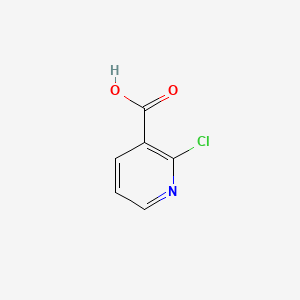
CAS · 2942-59-8
Product Overview
2-Chloronicotinic acid丨2942-59-8, is an organic compound that belongs to the class of halogenated derivatives of nicotinic acid (niacin). It features a chlorine atom attached to the second position of the pyridine ring, which is a characteristic structural feature of the compound. This compound plays an important role in the synthesis of several pharmaceuticals, agrochemicals, and functional materials, especially in the context of heterocyclic chemistry. It is also involved in the production of certain intermediate chemicals that serve as precursors to more complex molecules used in various industries.
Product Specifications
| Property | Specification |
|---|---|
| Appearance | White or off-white crystalline powder |
| Assay | 98.0% min |
| Water | 0.3% max |
| Melting point | 177.0°C min |
| Sulfated ash | 0.2% max |
| Single impurity | 0.2% max |
Applications
1. Pharmaceutical Industry
One of the major uses of 2-chloronicotinic acid is in the pharmaceutical industry. It serves as a critical precursor for the synthesis of various nicotinic acid derivatives and pyridine analogs that have potential medicinal benefits.
● Drug Synthesis: 2-Chloronicotinic acid is utilized in the synthesis of nicotine-like compounds, which are important in the treatment of diseases like nicotine addiction. Some of these derivatives also possess anti-inflammatory, analgesic, or antimicrobial properties.
● Nicotinic Receptor Agonists: It is a key intermediate in the production of nicotinic receptor agonists, which have applications in neurological disorders like Alzheimer's disease and Parkinson's disease. By modulating the activity of acetylcholine receptors, these compounds can help enhance cognitive function.
2. Agriculture and Agrochemicals
2-Chloronicotinic acid丨2942-59-8 is also used in the agrochemical industry, primarily for the synthesis of pesticides, herbicides, and other crop protection agents. Its structural similarity to nicotine allows it to play a role in developing compounds that target insect pests and weeds.
● Insecticides: Several insecticides are derived from 2-chloronicotinic acid or its derivatives. For example, neonicotinoids, which are widely used as systemic insecticides, can be synthesized using this compound. Neonicotinoids are effective against a broad spectrum of pests, including aphids, whiteflies, and fleas.
● Herbicides: In addition to insecticides, 2-chloronicotinic acid is involved in the synthesis of some herbicides. These herbicides can target specific enzymes in plants, inhibiting growth and development, and are used to control unwanted vegetation in agricultural fields and landscapes.
● Pesticides for Crop Protection: 2-Chloronicotinic acid-based compounds are also useful in the development of other pesticides that are used to protect crops from various pathogens and pests, thereby ensuring better yields in agriculture.
3. Materials Science
In materials science, 2-Chloronicotinic acid丨2942-59-8 is an important building block for the synthesis of functional materials and polymeric compounds. Due to the presence of the pyridine ring, it has been explored for use in the creation of polymers and complex materials.
● Polymeric Materials: Derivatives of 2-chloronicotinic acid can be polymerized to form conductive polymers or light-sensitive materials. These materials are used in various electronic and optical devices, including solar cells, LEDs, and semiconductors.
4. Organic Synthesis and Chemical Research
2-Chloronicotinic acid is frequently used as a synthetic intermediate in organic chemistry. It serves as a starting material for the synthesis of various complex heterocyclic compounds and aromatic systems, which have broad applications in different fields.
● Building Block for Heterocycles: The chloropyridine structure of 2-chloronicotinic acid makes it an excellent building block for creating heterocyclic compounds. These compounds are crucial in the synthesis of pharmaceuticals, biochemicals, and materials with specialized properties.
● ms of solubility, stability, or bioactivity, depending on the target application.
Benefits
1. Effective Synthetic Intermediate
2-Chloronicotinic acid is an excellent intermediate in organic synthesis, making it highly valuable in both pharmaceutical and agrochemical industries. Its ability to easily participate in substitution reactions and functional group modifications makes it versatile for creating a variety of compounds.
● Building Block for Complex Molecules: Its structure makes it a precursor for creating highly functionalized molecules that are pivotal for drug discovery and agriculture.
2. Biological Activity
The biological activity of 2-chloronicotinic acid and its derivatives is one of its most important advantages. Compounds derived from it often display antimicrobial, anti-inflammatory, and antitumor activities, which are valuable for developing new therapeutics and crop protection products.
● Insecticidal and Herbicidal Action: Its derivatives, especially in the form of neonicotinoids, offer highly effective pest control. This makes it a key ingredient in the development of safer, targeted pesticides with minimal environmental impact compared to older, more toxic compounds.
3. Environmental and Health Safety
Compared to certain other pesticides or industrial chemicals, 2-chloronicotinic acid derivatives generally exhibit low toxicity to mammals and a relatively short environmental half-life. This makes them safer for humans, animals, and ecosystems.
● Reduced Environmental Impact: The development of sustainable agrochemicals from this compound can help reduce the ecological impact of chemical pollutants in soil and water. This is important for maintaining biodiversity and ensuring the long-term health of ecosystems.
4. Wide Availability
2-Chloronicotinic acid is relatively easy to synthesize and commercially available, making it a cost-effective starting material for industrial applications. Its availability contributes to the scalability of manufacturing processes in pharmaceuticals, agrochemicals, and materials science.
● Accessible Raw Material: The widespread availability of 2-chloronicotinic acid means that it is a practical and economically viable option for large-scale industrial processes.
Conclusion
2-Chloronicotinic acid丨2942-59-8 is a valuable organic compound with significant applications in the pharmaceutical, agrochemical, and materials science industries. Its ability to act as a building block for the synthesis of complex molecules and pyridine-based derivatives makes it essential for creating medicinal compounds, pesticides, and functional materials. Its biological activity and versatility in chemical synthesis make it a vital component in developing novel drugs and environmentally friendly agrochemicals.
Previous
Next