
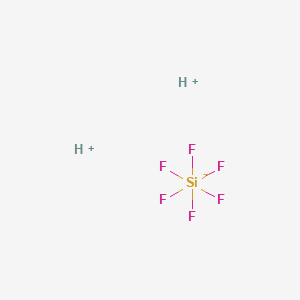
CAS · 16961-83-4
Product Overview
Hexafluorosilicic acid丨CAS 16961-83-4, also known as fluorosilicic acid or hydrofluorosilicic acid, is an inorganic compound. It is a colorless, fuming liquid with a sharp, irritating odor and is commonly produced as a by-product of phosphate fertilizer manufacturing. Hexafluorosilicic acid is primarily used in water fluoridation and as an intermediate in the production of various fluoride compounds.
Product Specifications
| Grade | NSF grade |
|---|---|
| Appearance | Colorless to light yellow liquid |
| H₂SiF₆ | 40% min |
| H₂SO₄ | 0.02% max |
| HF | 0.2% max |
| Fe | 0.01% max |
| Cd | 0.002% max |
| Pb | 0.002% max |
| Cu | 0.002% max |
| Hg | 0.002% max |
| As | 0.002% max |
Applications
A. Water Fluoridation
Hexafluorosilicic acid丨CAS 16961-83-4 is widely used for municipal water fluoridation to prevent dental caries (tooth decay).
It is added to public drinking water supplies in controlled concentrations (typically 0.7–1.2 mg/L fluoride).
Upon dissolution, it hydrolyzes to release fluoride ions that strengthen tooth enamel and reduce demineralization.
It is one of the most cost-effective and widely used fluoridating agents globally.
B. Production of Fluoride Compounds
H₂SiF₆ serves as a precursor to various fluoride-based chemicals, including:
Aluminum fluoride (AlF₃) – used in aluminum smelting
Cryolite (Na₃AlF₆) – flux in aluminum production
Magnesium and sodium fluorosilicates – for water treatment and industrial use
C. Electroplating and Metal Surface Treatment
Used in the electroplating industry to clean and etch metal surfaces, particularly in aluminum and magnesium processing.
Helps prepare surfaces for better adhesion of coatings or electroplated layers.
A component in pickling solutions and rust removal agents.
D. Ceramic and Glass Industry
Used in glass frosting and etching due to its ability to react with silica.
Enables the production of frosted or matte finishes on glass surfaces for decorative or functional purposes.
E. Concrete and Masonry Hardening
Applied to concrete and stone surfaces to enhance resistance to wear, water, and chemicals.
Reacts with calcium compounds in the substrate to form fluorosilicates, improving durability.
F. Industrial Cleaning
Used in acid-based cleaning agents for descaling boilers, cooling towers, and heat exchangers.
Removes mineral deposits and scale, especially those containing calcium and silica.
Benefits
A. Public Health (Dental Benefits)
Fluoridation of drinking water with hexafluorosilicic acid has led to a significant reduction in dental decay, particularly in communities with limited access to dental care.
It is endorsed by the World Health Organization (WHO), CDC, and other major health organizations as a safe and effective public health measure.
B. Industrial Efficiency
As a source of fluoride, H₂SiF₆ is economical and readily available from fertilizer industry by-products.
Plays a crucial role in aluminum refining and electrochemistry, which are vital to automotive, aerospace, and electronics industries.
C. Material Enhancement
When used in surface treatment, it improves resistance of materials to moisture, corrosion, and environmental wear, thus extending the life of industrial and architectural components.
D. Cost-Effective Chemical Feedstock
Its role as an intermediate in fluoride compound synthesis makes it an important economic driver in the fluorochemical value chain.
Conclusion
Hexafluorosilicic acid丨CAS 16961-83-4 is a highly versatile industrial chemical with its primary significance in water fluoridation, promoting oral health on a global scale. Beyond this, it plays a critical role in the production of fluoride compounds, metal treatment, ceramics, and cleaning industries. Its benefits are clear, especially in cost-effectiveness and functionality, but its corrosive and toxic nature demands careful handling, regulatory compliance, and environmental responsibility. As a product of industrial processes, it exemplifies resource efficiency and contributes meaningfully to both public health and industrial innovation.
Previous
Next