
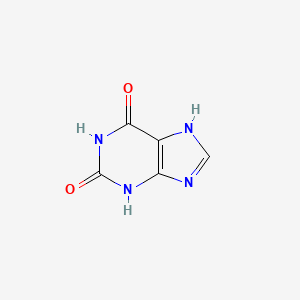
CAS · 69-89-6
Product Overview
Xanthine is a high-purity nucleosides-nucleotides supplied for industrial and specialty chemical applications. Contact our team for specifications, packaging options and lead times.
Product Specifications
| Description | White to slightly yellow powder |
|---|---|
| Purity by HPLC | 99.0% min |
| Solubility | Colorless solution to pale yellow solution |
| Identification | The HNMR spectrum conforms to structure |
Applications
1. Biochemical and Medical Research
Key intermediate in purine metabolism, serving as a precursor to uric acid.
Used in enzyme assays and metabolic studies to investigate:
Purine degradation
Enzyme activities (e.g., xanthine oxidase and xanthine dehydrogenase)
Disorders like gout, xanthinuria, and hyperuricemia
2. Pharmacological Research
Closely related to methylxanthines (e.g., caffeine, theobromine, theophylline), making it a starting point in the synthesis of:
Bronchodilators
Stimulants
Vasodilators
Studied for its role in adenosine receptor modulation, which affects cardiovascular and central nervous system function.
3. Antioxidant and Free Radical Studies
As a substrate for xanthine oxidase, it is used in generating reactive oxygen species (ROS) in experimental models.
Helps evaluate antioxidant capabilities of various compounds in in vitro oxidative stress assays.
4. Analytical Reagent
Employed in high-performance liquid chromatography (HPLC) and spectrophotometry to study purine metabolism.
Used as a reference compound for detecting purine bases in nucleic acid analysis.
5. Drug Design and Development
Serves as a scaffold molecule for synthetic analogs targeting:
Adenosine receptors (A1, A2A, A2B, A3)
Phosphodiesterase enzymes (PDEs)
Kinase inhibitors
Helps create bioactive derivatives with applications in CNS disorders, asthma, and cardiovascular diseases.
Benefits
1. Biological Relevance
Xanthine丨CAS 69-89-6 occurs naturally in the metabolic breakdown of purines in humans and animals.
Plays a vital role in understanding diseases associated with purine metabolism dysfunction, such as:
Gout
Renal lithiasis
Lesch–Nyhan syndrome
2. Research Utility
Easily incorporated into enzymatic reaction assays to study oxidative stress and antioxidant properties.
Its transformation by xanthine oxidase makes it useful in ROS generation studies, simulating inflammatory conditions.
3. Synthetic Flexibility
Acts as a precursor or intermediate in the production of numerous pharmaceutical and agrochemical molecules.
Its purine ring system offers diverse modification points for SAR (Structure–Activity Relationship) exploration.
4. Safe Handling and Low Cost
Compared to other purine analogs, xanthine is:
Non-toxic in moderate amounts
Commercially available at low cost
Stable under standard storage conditions
Conclusion
Xanthine丨CAS 69-89-6 is a biologically significant purine derivative that serves as both a metabolic intermediate and a versatile research compound. It is essential in studies of purine metabolism, oxidative stress, enzyme function, and drug discovery. Its structural similarity to bioactive methylxanthines, stability, and compatibility with biological systems make it a valuable component in biochemistry, pharmacology, and analytical chemistry.
Previous
Next