
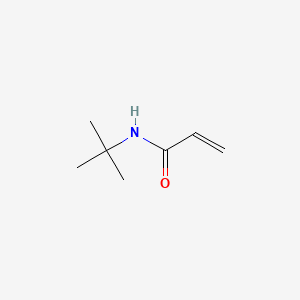
CAS · 107-58-4
Product Overview
N-tert-Butylacrylamide is a high-purity pharmaceutical-intermediates supplied for industrial and specialty chemical applications. Contact our team for specifications, packaging options and lead times.
Product Specifications
| Appearance | White fine crystals |
|---|---|
| Purity (by HPLC) | 99% min |
| Color (Apha) | 20 max |
| Melting point (°C) | 127–130 |
| Moisture (%) | 0.5% max |
| Sulphate (mg/kg, ppm) | 1000 max |
| Iron (ppm) | 5 max |
| Turbidity (NTU) | 1.0 max |
Applications
N-tert-Butylacrylamide (CAS 107-58-4) is a versatile monomer widely used in the synthesis of specialty polymers and functional materials. It is primarily employed in the production of temperature- and pH-responsive polymers, such as poly(N-tert-butylacrylamide) and copolymers with acrylamide or other monomers, which are used in biomedical applications, drug delivery systems, and smart hydrogels. Its hydrophobic tert-butyl group provides tunable solubility and lower critical solution temperature (LCST) behavior, making it suitable for stimuli-responsive materials that swell or collapse in response to environmental changes. Additionally, it is used in coatings, adhesives, and surface modification, where it enhances hydrophobicity, chemical resistance, and thermal stability. N-tert-butylacrylamide is also applied in research and industrial polymerization studies to create functional copolymers and responsive networks for a variety of material science applications.
Benefits
The benefits of N-tert-butylacrylamide come from its chemical versatility, hydrophobic modification, and stability under polymerization conditions. The tert-butyl group provides steric hindrance that improves polymer thermal and mechanical stability while allowing tunable hydrophilicity in copolymers. Its reactivity in free radical and controlled/living polymerization techniques enables precise control over polymer composition, molecular weight, and architecture. The monomer's solubility in organic solvents and compatibility with other acrylamide-based monomers facilitates easy incorporation into copolymers, hydrogels, and functional materials. These characteristics allow the creation of polymers with predictable stimuli-responsive behavior, enhanced durability, and targeted performance for biomedical, industrial, and materials science applications.
Conclusion
N-tert-butylacrylamide is a valuable monomer for producing responsive and high-performance polymers in biomedical, industrial, and materials applications. Its hydrophobic tert-butyl group, chemical stability, and polymerization versatility enable precise control of polymer properties and stimuli-responsive behavior. By supporting the development of smart hydrogels, copolymers, and functional materials, N-tert-butylacrylamide remains a key building block in modern polymer and material science research.
Previous
Next