CAS · 107-93-7
Product Overview
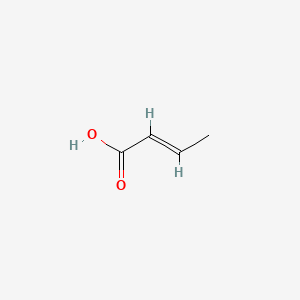
Crotonic acid is a high-purity pharmaceutical-intermediates supplied for industrial and specialty chemical applications. Contact our team for specifications, packaging options and lead times.
Product Specifications
| Appearance: | White particles |
|---|---|
| Assay (HPLC): | 99.0% min |
| Melting point: | 70.0–73.0°C |
| Water: | 0.6% max |
| Solution Colour (Visualization): | 10# max |
Applications
1. Polymer and Resin Manufacturing
Crotonic acid is a key monomer in the production of copolymers and resins.
Used in the copolymerization with vinyl acetate, acrylates, and other monomers to produce polymers with improved adhesion, water resistance, and thermal stability.
Such copolymers are widely used in coatings, adhesives, sealants, and paints.
2. Intermediate in Organic Synthesis
Serves as a building block in the synthesis of fine chemicals, agrochemicals, and pharmaceuticals.
The double bond and carboxylic acid functionalities allow for various chemical transformations, such as esterification, hydrogenation, halogenation, and Michael addition.
3. Pharmaceutical Applications
Used as a precursor or reagent in the synthesis of active pharmaceutical ingredients (APIs).
Functionalized derivatives of crotonic acid are found in anti-inflammatory, antimicrobial, and anticancer research.
4. Flavors and Fragrances
Although crotonic acid itself has a sharp, unpleasant odor, its esters (e.g., crotonates) are used in fragrance formulations.
Crotonate esters offer fruity, pleasant aromas and are incorporated into perfumes and flavoring agents.
5. Agrochemical Synthesis
Acts as a raw material for the synthesis of herbicides, pesticides, and plant growth regulators.
The reactive unsaturation and carboxyl group make it suitable for incorporation into bioactive molecules.
Benefits
1. Reactive Functional Groups
The trans double bond and carboxylic acid groups allow for diverse chemical reactivity.
Suitable for addition reactions, polymerization, and derivatization, making it a versatile intermediate.
2. Improves Material Performance
Copolymers containing crotonic acid have enhanced film-forming ability, adhesion, hardness, and solvent resistance.
Ideal for high-performance coatings and adhesives in industrial applications.
3. Biodegradability
Crotonic acid and its polymers can be biodegradable, depending on the formulation.
This makes it valuable in environmentally friendly materials and sustainable chemistry.
4. Cost-Effective and Commercially Available
It is an inexpensive, readily available chemical, making it practical for large-scale industrial applications.
Conclusion
Crotonic acid (CAS 107-93-7) is a highly versatile unsaturated carboxylic acid that plays a significant role in the fields of polymer chemistry, pharmaceuticals, agrochemicals, and flavor/fragrance production. Its chemical structure enables it to serve as a key intermediate for numerous reactions and polymerizations, while its benefits-such as high reactivity, biodegradability, and cost-effectiveness-make it valuable for both research and industrial-scale manufacturing. As sustainability and performance remain key drivers in material and chemical development, crotonic acid continues to be an essential compound across diverse applications.
Previous
4-Methylpiperidine丨CAS 626-58-4
Next