
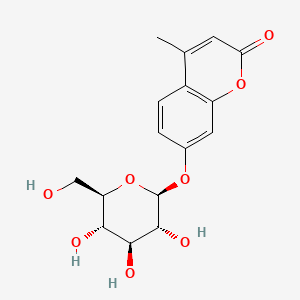
CAS · 18997-57-4
Product Overview
4-Methylumbelliferyl-beta-D-glucopyranoside is a high-purity pharmaceutical-intermediates supplied for industrial and specialty chemical applications. Contact our team for specifications, packaging options and lead times.
Product Specifications
| Appearance: | Off-white to white powder |
|---|---|
| Purity (HPLC): | 98% min |
| Specific Optical Rotation [α]20D (c=0.3 in water): | -108° to -97.5° |
| 1H NMR (DMSO): | Confirms to structure |
Applications
4-Methylumbelliferyl-β-D-glucopyranoside (CAS 18997-57-4) is a synthetic fluorogenic substrate widely used in biochemical and microbiological research. Structurally, it is a glycoside of 4-methylumbelliferone, and upon enzymatic hydrolysis by β-glucosidase, it releases a highly fluorescent product, 4-methylumbelliferone. This property makes it a powerful tool in enzyme assays, allowing researchers to measure β-glucosidase activity with high sensitivity and precision. It is extensively applied in microbiology for identifying and differentiating bacterial strains based on their enzymatic profiles, particularly in diagnostics and quality control testing. Additionally, it finds use in plant biology, where β-glucosidase activity is linked to metabolic and defense processes, as well as in pharmacological research to study glycosidase inhibitors and related therapeutic compounds.
Benefits
The benefits of 4-methylumbelliferyl-β-D-glucopyranoside are centered on its sensitivity, specificity, and versatility. Its fluorogenic nature enables rapid and accurate detection of enzymatic activity, which is critical for diagnostics, environmental monitoring, and research. Unlike traditional chromogenic substrates, it provides stronger signals and lower detection limits, improving assay reliability. In microbiology, it accelerates identification of pathogens, supporting timely interventions in healthcare and food safety. For pharmaceutical and biochemical research, it facilitates the study of enzyme kinetics, inhibitor screening, and metabolic pathways, driving innovation in drug discovery and enzyme engineering. Its broad applicability across multiple fields highlights its value as a universal research tool.
Conclusion
In conclusion, 4-methylumbelliferyl-β-D-glucopyranoside is a highly effective fluorogenic substrate that has become indispensable in enzymology, microbiology, and pharmaceutical research. By enabling sensitive, specific, and rapid detection of β-glucosidase activity, it contributes to scientific progress in diagnostics, healthcare, and biotechnology. Its combination of practicality and reliability ensures it remains a preferred choice in advancing both fundamental research and applied sciences.
Previous
1-Cyclohexylpiperazine丨CAS 17766-28-8
Next