
2,4-Difluoro-alpha-(1H-1,2,4-triazolyl)acetophenone
CAS 86404-63-9
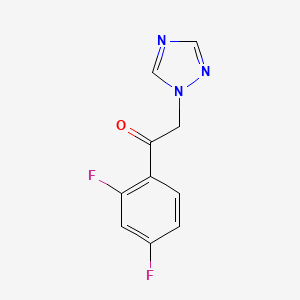
CAS · 86404-63-9
Product Overview
2,4-Difluoro-alpha-(1H-1,2,4-triazolyl)acetophenone is a high-purity pharmaceutical-intermediates supplied for industrial and specialty chemical applications. Contact our team for specifications, packaging options and lead times.
Product Specifications
| Appearance: | White to pale yellow crystalline powder |
|---|---|
| Assay: | 98.0% to 102.0% |
| Melting Point: | 103℃~112℃ |
| Identification: | HPLC |
| Related substance | Each impurity: 0.5% max Total impurities: 1.0% max |
| Moisture Content: | 0.5% max |
Applications
1. Pharmaceutical Intermediate
Primarily used as a key intermediate in the synthesis of azole-based antifungal agents, particularly fluconazole analogs.
The 1,2,4-triazole moiety is common in compounds with antifungal, antiviral, and anti-inflammatory properties.
The difluoroacetophenone unit contributes to bioactivity modulation and enhanced binding affinity in enzyme active sites.
2. Agrochemical Research
Serves as a building block in the synthesis of fungicides and pesticides with azole or triazole structures.
Triazole-based agrochemicals are known for their broad-spectrum activity and resistance to biodegradation.
3. Heterocyclic Chemistry
Acts as a versatile starting material or intermediate in the development of complex heterocycles.
Useful in academic and industrial research for creating libraries of bioactive triazole derivatives.
4. Enzyme Inhibitor Scaffold
The compound's structure makes it a candidate scaffold for developing enzyme inhibitors, particularly cytochrome P450 or lanosterol 14α-demethylase inhibitors - a key mode of action for azole antifungals.
Benefits
1. Pharmacophore Integration
Combines two important pharmacophores:
1,2,4-Triazole ring (for hydrogen bonding, coordination with metal ions in enzymes)
Difluoroacetophenone (enhanced metabolic stability and lipophilicity)
This dual nature improves bioavailability and biological activity.
2. Enhanced Bioactivity
Fluorine atoms increase lipophilicity, membrane permeability, and metabolic resistance, which are crucial for drug-like behavior.
Helps in improving the binding selectivity and potency of the final active compound.
3. Synthetic Flexibility
Amenable to further chemical modification at:
The ketone group (e.g., oxime formation, reductive amination)
The aromatic ring (e.g., substitution or coupling)
The triazole nitrogen (N-alkylation or N-oxide derivatization)
This allows tailoring of derivatives for structure–activity relationship (SAR) studies.
4. Utility in Lead Optimization
Serves as a valuable core structure in medicinal chemistry for optimizing lead compounds during early-stage drug development.
Conclusion
2,4-Difluoro-α-(1H-1,2,4-triazolyl)acetophenone (CAS 86404-63-9) is a highly functionalized intermediate integrating a bioactive triazole ring with a difluoro-substituted acetophenone backbone. It plays a crucial role in the synthesis of azole-based pharmaceuticals and agrochemicals, especially antifungal agents. Its dual pharmacophoric features provide synthetic versatility and enhanced biological potential, making it valuable for both research and industrial drug development.
Previous
Next