
(1S,2S)-(+)-N-(4-Toluenesulfonyl)-1,2-diphenylethylenediamine
CAS 167316-27-0
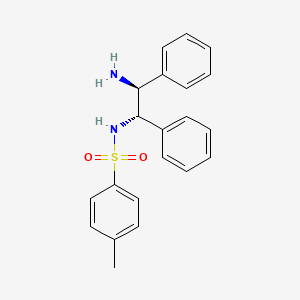
CAS · 167316-27-0
Product Overview
(1S,2S)-(+)-N-(4-Toluenesulfonyl)-1,2-diphenylethylenediamine is a high-purity pharmaceutical-intermediates supplied for industrial and specialty chemical applications. Contact our team for specifications, packaging options and lead times.
Product Specifications
| Appearance | White to pale yellow crystal or powder |
|---|---|
| Purity | 98.0% min |
| Optical purity (e.e) | 99.0% min |
| Specific rotation [α]D20 (c=1, CHCl3) | +33.0° ~ +36.0° |
| Clarity | Conforms |
| Melting Point | 124°C ~ 129°C |
Applications
This compound is a chiral diamine widely used as a ligand in asymmetric synthesis and catalysis. It is applied in the development of enantioselective reactions, including asymmetric hydrogenation, addition, and cyclization processes. Its rigid structure and stereochemistry make it valuable for producing optically active compounds in pharmaceuticals, fine chemicals, and agrochemicals. Additionally, it serves as a building block in the preparation of other chiral ligands and catalysts used in both academic research and industrial synthesis of enantiomerically pure products.
Benefits
The benefits of this chiral diamine include high enantioselectivity, steric control, and chemical stability. Its sulfonyl-protected amino groups enhance solubility and handling while maintaining reactivity for ligand formation and catalytic activity. The stereochemically defined backbone allows precise control over asymmetric transformations, improving reaction efficiency and product purity. Its compatibility with a variety of transition metals and reaction conditions makes it a versatile tool in asymmetric synthesis and industrial-scale production of chiral compounds.
Conclusion
(1S,2S)-(+)-N-(4-Toluenesulfonyl)-1,2-diphenylethylenediamine is a chiral diamine ligand used in asymmetric catalysis and synthesis of enantiomerically pure compounds. Its benefits include high enantioselectivity, steric and chemical stability, and versatility in catalysis. By enabling precise asymmetric transformations, it plays a critical role in pharmaceutical development, fine chemical production, and advanced synthetic research.
Previous
5,5-isopropylidenebis(m-xylene-2,alpha,alpha-triol)丨CAS 3957-22-0
Next