
(1R,2R)-(-)-N-(4-Toluenesulfonyl)-1,2-diphenylethylenediamine
CAS 144222-34-4
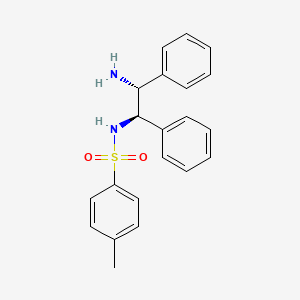
CAS · 144222-34-4
Product Overview
(1R,2R)-(-)-N-(4-Toluenesulfonyl)-1,2-diphenylethylenediamine is a high-purity pharmaceutical-intermediates supplied for industrial and specialty chemical applications. Contact our team for specifications, packaging options and lead times.
Product Specifications
| Appearance | White to light yellow crystals or powder |
|---|---|
| Content | 98.0% min |
| Optical purity (e.e) | 99.0% min |
| Specific rotation [α]D20(c=1, CHCl₃) | -33° to -36° |
| Clarity | Qualified |
| Melting point | 124 - 129 °C |
Applications
(1R,2R)-(-)-N-(4-Toluenesulfonyl)-1,2-diphenylethylenediamine is an important chiral ligand commonly used in asymmetric synthesis, particularly in the preparation of optically active compounds. It is widely employed in catalysis, especially in the field of organocatalysis, where it facilitates reactions that produce enantiomerically pure products. The compound is often used in the synthesis of pharmaceuticals, agrochemicals, and other biologically active molecules, where chirality plays a critical role in determining the biological activity of the resulting compounds. In addition, this ligand is employed in enantioselective reactions such as alkylation, addition, and reduction reactions, enabling the synthesis of complex organic molecules with high stereoselectivity. Its applications extend to the production of fine chemicals, including natural product synthesis and the creation of specialty materials with specific chiral properties.
Benefits
The primary benefits of (1R,2R)-(-)-N-(4-Toluenesulfonyl)-1,2-diphenylethylenediamine lie in its ability to serve as a highly efficient chiral ligand in asymmetric synthesis. By promoting enantioselectivity, it allows the synthesis of compounds with high purity and the desired stereochemistry, which is crucial for ensuring the biological activity of pharmaceuticals and other bioactive molecules. Its effectiveness in catalyzing reactions in a selective manner also contributes to the efficiency and cost-effectiveness of synthetic processes. The compound's role in the production of fine chemicals and natural products makes it valuable for the synthesis of complex molecules with intricate stereochemistry. Additionally, its versatility as a ligand in various catalytic reactions further enhances its value in both research and industrial applications, particularly in the development of novel and functional chiral materials.
Conclusion
(1R,2R)-(-)-N-(4-Toluenesulfonyl)-1,2-diphenylethylenediamine (CAS 144222-34-4) is a key chiral ligand used in asymmetric synthesis, enabling the creation of optically active compounds with high enantiomeric purity. Its applications in catalysis make it an invaluable tool in the synthesis of pharmaceuticals, agrochemicals, and other biologically active molecules, where chirality is critical for efficacy. By facilitating enantioselective reactions, the compound improves the efficiency of synthetic processes, making it a valuable asset in both research and industrial settings. Its ability to assist in the synthesis of complex molecules, including natural products and specialty chemicals, underscores its importance in the development of novel materials and therapeutics. Overall, (1R,2R)-(-)-N-(4-Toluenesulfonyl)-1,2-diphenylethylenediamine plays a pivotal role in advancing chiral chemistry and enantioselective synthesis.
Previous
Next