
CAS · 128446-32-2
Product Overview
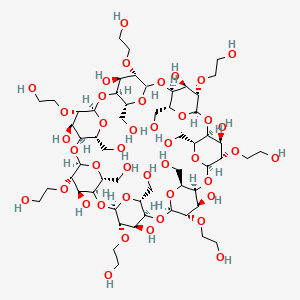
beta-Cyclodextrin, 2-hydroxyethyl ethers丨CAS 128446-32-2 is a cyclic oligosaccharide composed of seven glucose units linked by α-1,4 glycosidic bonds, forming a toroidal (doughnut-like) structure with a hydrophobic inner cavity and hydrophilic exterior.
2-Hydroxyethyl ethers of beta-cyclodextrin are chemically modified derivatives where some or all of the hydroxyl groups on β-CD have been converted to 2-hydroxyethyl ethers. This modification increases solubility in water and can alter inclusion complexation properties.
Product Specifications
| Appearance: | White or almost white, amorphous or crystalline powder |
|---|---|
| Solubility: | Freely soluble in water |
| Clarity of Solution: | The solution is clear |
| Conductivity: | 200 μS/cm max |
| MS: | 0.40 ~ 1.50 |
| Specific Rotation: | +120.0 ~ +140.0° |
| Degree of Substitution (7*MS): | 2.80 ~ 10.50 |
| Propylene Glycol: | 2.5% max |
| Water: | 10.0% max |
| Heavy Metals: | 20 ppm max |
| Total Aerobic Microbial Count: | 10³ cfu/g max |
| Total Combined Molds and Yeasts Count: | 10² cfu/g max |
| Escherichia Coli: | Absent |
Applications
1. Pharmaceutical Industry
Used as a solubilizing agent and drug delivery enhancer for poorly water-soluble drugs.
Forms inclusion complexes with drugs, improving their stability, bioavailability, and controlled release.
The hydroxyethyl modification increases aqueous solubility compared to native beta-cyclodextrin, broadening pharmaceutical formulation possibilities.
2. Food Industry
Acts as a flavor stabilizer and odor masker by forming complexes with volatile or unstable compounds.
Used in encapsulating sensitive nutrients, antioxidants, or flavors to enhance shelf-life and delivery.
3. Cosmetics and Personal Care
Used for controlled release of fragrances, vitamins, and active ingredients.
Improves solubility and stability of ingredients in cosmetic formulations.
4. Chemical and Environmental Applications
Acts as a host molecule for trapping hydrophobic organic compounds in aqueous environments.
Used in wastewater treatment for removal of pollutants and organic contaminants.
Enhances solubility and delivery of catalysts or reagents in green chemistry.
5. Analytical Chemistry and Biotechnology
Used in chromatographic separations to improve selectivity by inclusion complex formation.
Facilitates enzyme stabilization and protein formulation by preventing aggregation.
Benefits
Improved aqueous solubility compared to native beta-cyclodextrin, enhancing usability in aqueous formulations.
Ability to form inclusion complexes with a wide variety of guest molecules, increasing solubility, stability, and bioavailability.
Biocompatible, biodegradable, and generally regarded as safe (GRAS) for many applications.
Versatile functionalization allows tailoring of physicochemical properties for specific uses.
Enhances formulation stability in pharmaceuticals, foods, and cosmetics.
Conclusion
A concise summary and suitability assessment for this product is available on request. Contact our team to discuss whether it fits your process and quality requirements.