
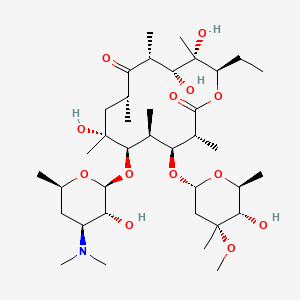
CAS · 114-07-8
Product Overview
Erythromycin is a high-purity a-api supplied for industrial and specialty chemical applications. Contact our team for specifications, packaging options and lead times.
Product Specifications
| Grade: | USP-NF2024 |
|---|---|
| Appearance: | White or off-white crystals or powder, odorless, slightly hygroscopic |
| Spectroscopy identification tests - Infrared Spectroscopy: | Meets the requirement |
| HPLC Identification: | The retention times of erythromycin A, B, and C in the sample correspond to those of standard solutions |
| Assay: | 85.0% - 100.5% |
| Erythromycin A (Ery-A): | / |
| Erythromycin B (Ery-B): | 12.0% max |
| Erythromycin C (Ery-C): | 5.0% max |
| Residue on ignition: | 0.2% max |
| Limit of thiocyanate: | 0.3% max |
| Erythromycin A enol ether: | 3.0% max |
| Largest single impurity: | 3.0% max |
| Optical rotation: | -71° ~ -78° |
| Water Determination: | 10.0% max |
| Total Aerobic Microbial Count (TAMC): | 10³ cfu/g max |
| Total Yeast and Mold Count (TYMC): | 10² cfu/g max |
Applications
1. Pharmaceutical and Medical Use
a. Treatment of Bacterial Infections
Erythromycin is used to treat a wide range of bacterial infections, including:
● Upper and lower respiratory tract infections (e.g., pharyngitis, pneumonia, bronchitis)
● Skin and soft tissue infections
● Ear infections (e.g., otitis media)
● Eye infections (e.g., conjunctivitis)
● Gastrointestinal infections, particularly those caused by Campylobacter jejuni
● Genital infections, including Chlamydia trachomatis and Mycoplasma genitalium
● Whooping cough (Bordetella pertussis)
It is particularly valuable for penicillin-allergic patients and is often used as an alternative to beta-lactam antibiotics.
b. Topical and Dermatological Use
● Erythromycin is widely used in topical formulations (creams, gels, solutions) for treating acne vulgaris.
● It works by reducing bacterial load (especially Cutibacterium acnes) and inflammation, which are central to acne pathogenesis.
● Often combined with other agents like benzoyl peroxide or tretinoin for synergistic effects.
c. Ophthalmic Preparations
● Erythromycin ophthalmic ointment is used to treat eye infections and as prophylaxis in newborns to prevent neonatal conjunctivitis caused by Neisseria gonorrhoeae or Chlamydia trachomatis.
d. Gastrointestinal Motility Agent
● Erythromycin丨CAS 114-07-8 has prokinetic effects due to its action on motilin receptors, and is sometimes used off-label to manage gastroparesis and delayed gastric emptying in critically ill patients.
2. Veterinary Medicine
● Erythromycin丨CAS 114-07-8 is used in the treatment of infections in livestock and poultry, especially respiratory infections caused by susceptible organisms.
● Also used in aquaculture, particularly in fish, to treat bacterial gill disease, fin rot, and systemic infections caused by Aeromonas or Vibrio species.
3. Biotechnology and Microbiological Research
● Erythromycin is used in microbiological studies as a selective agent in growth media to inhibit or control specific bacterial populations.
● In genetic engineering, erythromycin resistance genes are used as selectable markers in plasmid vectors to confirm successful transformation in bacteria.
Benefits
1. Broad-Spectrum Antibacterial Activity
● Erythromycin丨CAS 114-07-8 is effective against many Gram-positive bacteria, such as Streptococcus, Staphylococcus, and Corynebacterium species.
● It also targets atypical pathogens like Mycoplasma pneumoniae, Chlamydia spp., and Legionella pneumophila, which makes it valuable in treating atypical pneumonias.
2. Safe for Penicillin-Allergic Patients
● For individuals allergic to penicillins or cephalosporins, erythromycin is a safe and effective alternative, especially for treating respiratory and skin infections.
3. Well-Studied with Decades of Clinical Use
● Erythromycin has a long-established safety and efficacy profile, making it a reliable choice for many bacterial infections.
● Its use in pediatrics, ophthalmology, dermatology, and geriatrics is well documented.
4. Versatility of Formulations
● Available in oral tablets, capsules, suspensions, topical gels, injectable forms, and ophthalmic ointments, erythromycin offers flexibility in administration across age groups and medical conditions.
● Topical formulations reduce systemic side effects while effectively targeting skin infections.
5. Anti-Inflammatory Effects
● In dermatological applications, erythromycin exerts anti-inflammatory effects that are beneficial in reducing redness, swelling, and pus formation in acne and rosacea.
● These properties enhance its role in long-term acne management, especially in patients who cannot tolerate retinoids.
Resistance and Limitations
● Overuse and misuse of erythromycin have contributed to the emergence of resistant strains, especially among Staphylococcus aureus and Streptococcus pneumoniae.
● Resistance mechanisms include methylation of ribosomal binding sites, efflux pumps, and enzymatic degradation.
● For this reason, erythromycin is now less preferred for some infections unless susceptibility is confirmed.
Conclusion
Erythromycin丨CAS 114-07-8 remains a cornerstone macrolide antibiotic used in human and veterinary medicine, dermatology, ophthalmology, and microbiological research. Its efficacy against a wide range of bacterial pathogens, its anti-inflammatory properties, and its availability in multiple formulations contribute to its enduring utility.
Previous
Sodium Deoxycholate丨CAS 302-95-4
Next
Conclusion
A concise summary and suitability assessment for this product is available on request. Contact our team to discuss whether it fits your process and quality requirements.